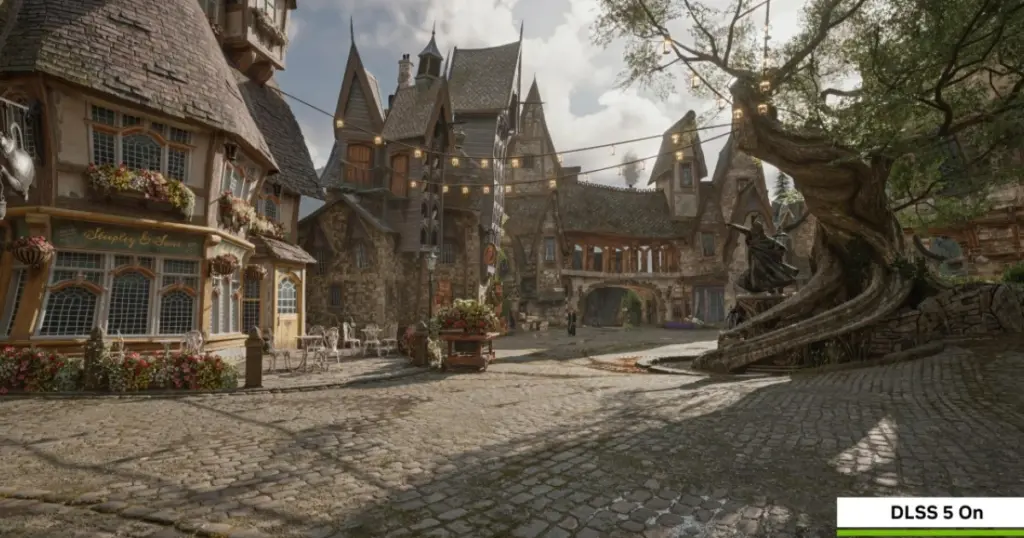
- Nvidia unveiled an updated DLSS 5 model, trimming parameter size by roughly 24% down to 118 million parameters.
- Hardware performance overhead dropped from 60% down to approximately 30–33%, alongside a 20% VRAM reduction at 4K.
- Character modifications have been dialed back: the upcoming November 5 update for Hogwarts Legacy focuses exclusively on environmental lighting and materials.
Addressing Character Artifacts and Model Footprint
When Nvidia initially unveiled its DLSS 5 Neural Rendering technology in March, PC gamers voiced strong concerns over generative AI alterations applied to in-game characters. The original demonstrations visibly altered character geometry and ages, notably transforming the 15-year-old student in Hogwarts Legacy and altering Grace in Resident Evil Requiem. Following community pushback, developers and Nvidia adjusted the scope of the neural pipeline.
Launching alongside the RTX Spark mobile hardware ecosystem, the revised October model decreases the neural network footprint down to roughly 118 million parameters—a 24% reduction achieved through curated training data. According to technical specifications, the updated model halves the GPU processing penalty compared to the September release and cuts 4K VRAM consumption by 20%.
Benchmarking the Update: 25% Uplift at 1440p
Hands-on testing using preview dynamic link library (.dll) files on an Asus ProArt P16 laptop equipped with an ARM processor and RTX Spark silicon revealed significant gains in NBA 2K27. The test suite ran with DLSS Super Resolution set to Balanced mode and 4x Multi Frame Generation enabled.
| Configuration | Resolution | Avg FPS | 1% Low FPS | PC Latency (ms) |
|---|---|---|---|---|
| DLSS 5 Off | 1080p High | 227 | 93 | 68 |
| DLSS 5 On (Original) | 1080p High | 143 | 63 | 88 |
| DLSS 5 On (Oct Update) | 1080p High | 168 | 61 | 85 |
| DLSS 5 Off | 1440p High | 200 | 61 | 76 |
| DLSS 5 On (Original) | 1440p High | 107 | 47 | 117 |
| DLSS 5 On (Oct Update) | 1440p High | 134 | 51 | 92 |
At 1440p, the revised neural pipeline boosted average frame rates from 107 FPS to 134 FPS, representing a 25% performance uplift over the initial build. While turning on DLSS 5 originally halved rendering performance, the revised iteration stabilizes the penalty at approximately 33%.
Implementation in Hogwarts Legacy and Where Winds Meet
The revised implementation will officially land in Hogwarts Legacy on November 5. Official comparison materials show that Warner Bros. masked out character facial rendering, dedicating the neural renderer solely to dynamic lighting, atmospheric effects, and material fidelity across the castle environment.
A similar strategy is slated for the action RPG Where Winds Meet, which will incorporate DLSS 5 support in the near future. Rather than applying beauty filters to human models, the technology remains focused entirely on environmental enhancement.
By confining DLSS 5 to lighting and architectural shaders while halving its performance cost, Nvidia and participating developers have turned an overly aggressive generative filter into a viable, performance-conscious enhancement for modern PC rendering pipelines.



A 30% performance penalty is still quite steep for environmental lighting enhancements, even with the parameter reductions. Masking out character models also sounds like a complex integration headache for developers. I wonder if the visual payoff truly justifies the implementation cost and added latency on mid-range hardware.