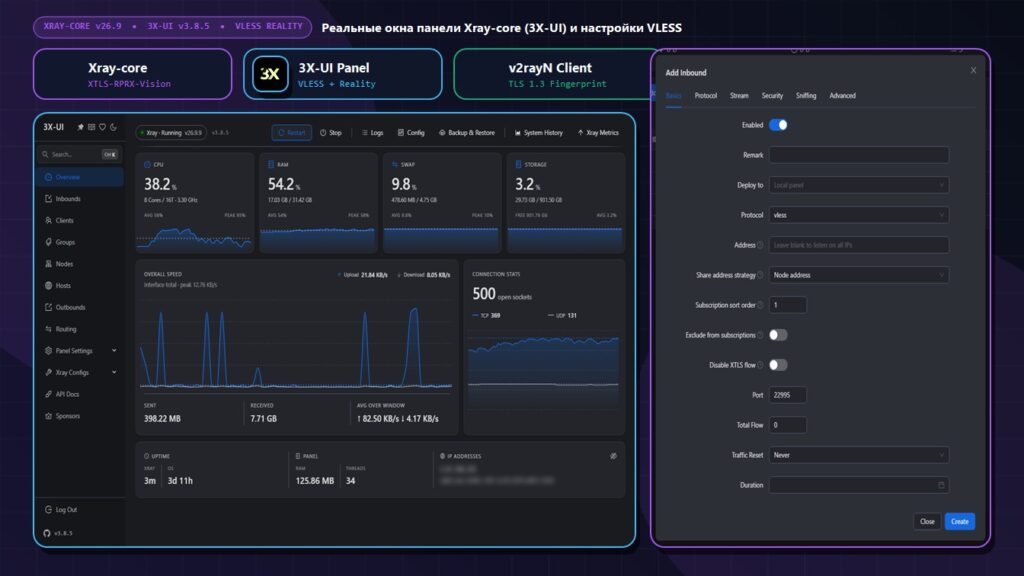
When architecting secure enterprise gateways over TCP/TLS, security engineers face two core challenges: the CPU and statistical overhead of double encryption (TLS-inside-TLS) and vulnerability to automated Active Probing by internet-wide scanners such as Shodan and Censys. In this technical study, we examine the byte-level cryptographic mechanics of the VLESS protocol paired with XTLS-RPRX-Vision and REALITY pre-authentication.
- Stateless VLESS Framing: Eliminates redundant inner symmetric ciphers in favor of native TLS 1.3 (RFC 8446) security, using a lightweight 16-byte session
UUIDheader. - REALITY Zero-Trust Pre-Authentication: Embeds an AEAD-authenticated token (derived via
X25519 ECDH+ShortId) directly inside the 32-byteSessionIdfield of the initial TLS 1.3 ClientHello packet, neutralizing active probing. - XTLS-RPRX-Vision Flow: Pads inner TLS handshake frames and switches to zero-copy packet splicing once inner TLS 1.3 Application Data begins, eliminating double encryption overhead.
- SOC / NGFW Detection Telemetry: Modern enterprise NGFWs detect unauthorized Reality tunnels primarily via SNI-to-ASN / Reverse DNS mismatch correlation rather than static TLS packet signatures.
1. How REALITY Authenticates Clients Inside TLS 1.3 ClientHello
Traditional TLS gateways expose their certificates in public Certificate Transparency (CT) logs and respond predictably to active probers. REALITY embeds client authentication directly into the initial TLS 1.3 ClientHello:
- The client generates an ephemeral
X25519keypair in thekey_shareextension and computes a shared ECDH secret using the gateway’s pre-shared public key. - Using this derived key, the client encrypts an AEAD payload containing the protocol version, timestamp, and
ShortId, placing the ciphertext inside the 32-byteSessionIdfield ofClientHello. - If the gateway validates the AEAD tag, it completes the tunnel session; if verification fails (e.g., an unauthorized scanner), it transparently forwards the raw TCP stream to a designated target server without exposing any local certificate.
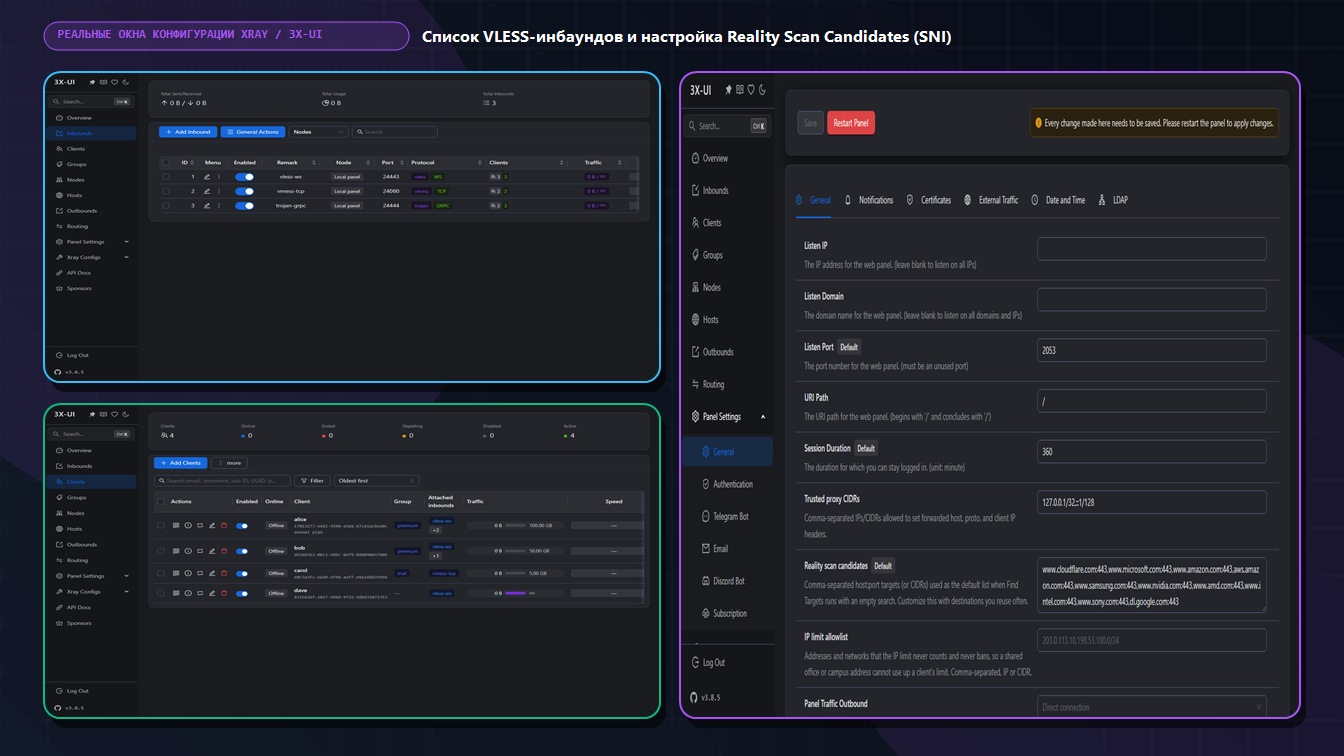
2. Eliminating TLS-in-TLS Overhead with XTLS-RPRX-Vision
When an encrypted HTTPS session runs inside an outer TLS tunnel, encrypting already-encrypted TLS records wastes CPU cycles and creates recognizable packet-length signatures. xtls-rprx-vision inspects record headers (0x16 0x03 vs 0x17 0x03 0x03), applies randomized padding during the inner handshake, and transitions to direct zero-copy forwarding (leveraging Linux splice(2)) once inner application data flows.
| Protocol Feature | Shadowsocks (AEAD-2022) | VMess + WS + TLS | Trojan-TLS | VLESS + XTLS-Vision + REALITY |
|---|---|---|---|---|
| Outer Wire Format | Raw high-entropy stream | HTTPS WebSocket | TLS 1.3 (Own Cert) | TLS 1.3 (Auth in ClientHello) |
| Active Probing Defense | Low / Moderate | Exposed in CT Logs | Exposed in CT Logs | High (Zero certificate footprint) |
| Inner TLS Double Encryption | Yes | Yes (High CPU load) | Yes | Eliminated via xtls-rprx-vision |
Frequently Asked Questions (FAQ)
How does XTLS-RPRX-Vision avoid double encryption?
Once the inner TLS 1.3 session completes its handshake and begins transmitting encrypted Application Data records (0x17 0x03 0x03), Vision stops re-encrypting those frames at the outer layer and forwards them directly.
How do enterprise NGFWs identify unauthorized Reality connections?
Enterprise NGFWs correlate the cleartext SNI hostname in ClientHello against the destination IP’s BGP Autonomous System (ASN) and DNS history, flagging sessions where the destination VPS subnet does not match the claimed SNI domain.
- AmneziaWG 3.1 Protocol & Amnezia 5.0.1.5 Architecture Research: WireGuard Header Randomization and Enterprise Tunnel Protection Against DPI Fingerprinting
- CSQTT Architecture Research (Rust / TURN / RTP): Multi-Stream Traffic Encapsulation in WebRTC Media Relays and Network Dispatcher Analysis
- VLESS Protocol & XTLS Reality Architecture: Cryptographic Analysis of TLS 1.3 Handshake, Active Probing Defense, and Zero-Overhead Vision Flow (Current Article)
- Comparative Analysis of Modern Network Transport Protocols (2026): Hysteria 2 (QUIC), TUIC v5, ShadowTLS v3, WireGuard, and OpenVPN DCO in Enterprise Networks
- DPI Traffic Analysis Technologies & TCP/TLS Packet Fragmentation Optimization: Architectural Breakdown of Zapret (nfqws) and ByeDPI from a Network Engineering Perspective



We migrated our remote edge tunnels to VLESS-Reality six months ago, and the CPU drop on low-spec VPS nodes with Vision flow is night and day. Just be careful with your SNI selection: pick a domain hosted on the exact same ASN and subnet as your server, otherwise corporate NGFWs flag the routing mismatch almost immediately.