Classic WireGuard revolutionized enterprise cryptography with its concise codebase and high-speed ChaCha20-Poly1305 kernel-space encryption. Yet from the standpoint of network steganography and defending corporate links against traffic fingerprinting, baseline WireGuard has a fundamental architectural trait: deterministic fixed-length headers. In this engineering deep dive, we examine the architecture of the open-source Amnezia 5.0.1.5 stack and the evolution of the AmneziaWG 3.1 transport protocol-from dynamic Magic Header ranges to statistical packet entropy smoothing.
- Why Baseline WireGuard Is Easily Fingerprinted: A static 4-byte message type header (
0x01..0x04) and rigid handshake payload sizes (148 bytesfor Handshake Initiation and92 bytesfor Handshake Response) allow DPI/NGFW engines to classify a tunnel on the very first UDP packet. - AmneziaWG 3.1 Protocol Advances: Moves from static constants to dynamic header ranges (
H1-H4), Custom Protocol Signature (CPS) decoy packets (I1-I5emulating QUIC, STUN, or DNS frames), and inter-packet timing jitter. - Amnezia 5.0.1.5 Enterprise Architecture: Built around self-hosted SSH container orchestration on dedicated corporate servers with zero third-party cloud relays or metadata leakage.
- SOC / Blue Team Perspective: Modern enterprise NGFWs are shifting from simple 4-byte offset rules to Shannon entropy and Inter-Arrival Time (IAT) flow telemetry.
1. Why Standard WireGuard Is Instantly Classified by Traffic Analyzers
Designed by Jason Donenfeld around the Noise_IKpsk2 framework, WireGuard was engineered as a streamlined replacement for complex IPSec and OpenVPN deployments. It intentionally omits cipher-suite negotiation: every peer uses Curve25519, ChaCha20-Poly1305, BLAKE2s, and SipHash24.
That determinism makes standard WireGuard trivial to identify on L4/L7 network sensors (Wireshark, Suricata, Zeek, and hardware NGFWs):
- Static First 4 Bytes: Every packet starts with a 1-byte type identifier (
0x01Initiation,0x02Response,0x03Cookie Reply,0x04Transport Data) followed by three reserved zero bytes (0x00 0x00 0x00). - Fixed Handshake Geometry: Handshake Initiation is always exactly 148 bytes of UDP payload, Handshake Response is exactly 92 bytes, and Cookie Reply is 64 bytes.
# Sample BPF/Wireshark filter detecting standard WireGuard Handshakes:
udp and (
  (udp.length == 156 and udp[8:4] == 0x01000000) or
  (udp.length == 100 and udp[8:4] == 0x02000000)
)
2. AmneziaWG 3.1 Protocol Architecture: Dynamic Headers & Statistical Mimicry
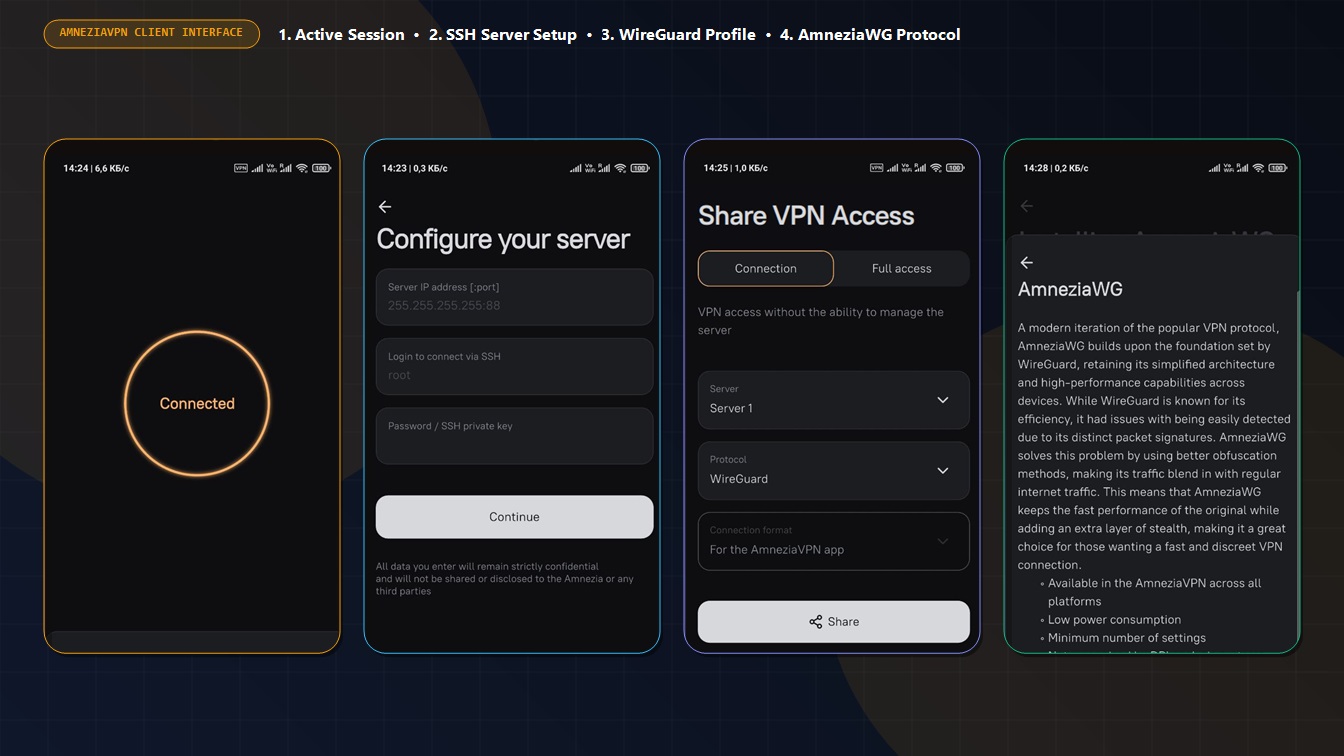
AmneziaWG modifies the WireGuard transport layer while preserving its underlying Noise_IK cryptography. In AmneziaWG 3.1 (shipped with the Amnezia 5.0.1.5 ecosystem), obfuscation operates across four distinct layers:
- Dynamic Magic Header Ranges (
H1-H4): Administrators define non-overlapping numeric intervals (e.g.,H1 = 214050100-214050900). Each transmitted packet picks a random 32-bit integer within its assigned range. - Randomized Padding Prefixes (
S1-S4): Prepends random-length padding before the handshake and transport structures, shifting cryptographic field offsets and altering packet lengths. - Pre-Handshake Junk Trains (
Jc,Jmin,Jmax): InjectsJcnoise packets bounded betweenJminandJmaxbytes prior to session initiation. - Custom Protocol Signatures (
I1-I5CPS): Structured byte templates (<b 0x...>static bytes,<r N>random bytes,<t>timestamp,<c>counter) that mimic legitimate UDP protocols such as QUIC Initial (RFC 9000) or STUN (RFC 5389).
3. Comparison Table: Standard WireGuard vs. AmneziaWG 3.1 & Enterprise Transports
| Architecture Metric | Standard WireGuard | OpenVPN 2.6 DCO | AmneziaWG 1.5 | AmneziaWG 3.1 (Client 5.0.1.5) |
|---|---|---|---|---|
| Transport Layer | UDP (Static Format) | UDP / TCP | UDP (Modified) | UDP + CPS Protocol Mimicry |
| Header Identifier | Static 0x01..0x04 |
Opcode + Session ID | Static custom H1-H4 |
Dynamic ranges H1-H4 + S1-S4 |
| Handshake Init Size | Strictly 148 bytes | Variable (TLS) | 148 + S1 bytes |
Dynamic + I1-I5 CPS preamble |
| Passive DPI Resilience | Low (1-packet detection) | Low (TLS/Opcode signature) | Moderate | High (QUIC/STUN structural mimicry) |
ChaCha20-Poly1305 cryptographic integrity.
Frequently Asked Questions (FAQ)
Does AmneziaWG 3.1 degrade throughput compared to standard WireGuard?
During active data transfer, throughput overhead is negligible (under 2-4%) because junk packets (Jc) and CPS signatures (I1-I5) are only transmitted during session handshake and rekeying.
How do enterprise NGFWs inspect modified UDP tunnels?
Advanced NGFWs validate full protocol state machines-verifying whether an initial QUIC header is followed by a specification-compliant RFC 9001 encrypted handshake-and analyze inter-arrival timing and payload entropy.
- AmneziaWG 3.1 Protocol & Amnezia 5.0.1.5 Architecture Research: WireGuard Header Randomization and Enterprise Tunnel Protection Against DPI Fingerprinting (Current Article)
- WebRTC, TURN, and RTP Media Tunneling Architecture Research: Stream Analysis, Network Dispatchers, and Practical Implementation in CSQTT
- VLESS Protocol & XTLS Reality Architecture: Cryptographic Analysis of TLS 1.3 Handshake, Active Probing Defense, and Zero-Overhead Vision Flow
- Comparative Analysis of Modern Network Transport Protocols (2026): Hysteria 2 (QUIC), TUIC v5, ShadowTLS v3, WireGuard, and OpenVPN DCO in Enterprise Networks
- DPI Traffic Analysis Technologies & TCP/TLS Packet Fragmentation Optimization: Architectural Breakdown of zapret2 v1.0.5.2 (bol-van) and ByeByeDPI (romanvht)


The shift from fixed byte offsets to Shannon entropy analysis is fascinating. How does AmneziaWG’s timing jitter affect latency-sensitive corporate traffic like VoIP? I’d love to hear how other network admins balance packet padding overhead against throughput on high-bandwidth links.