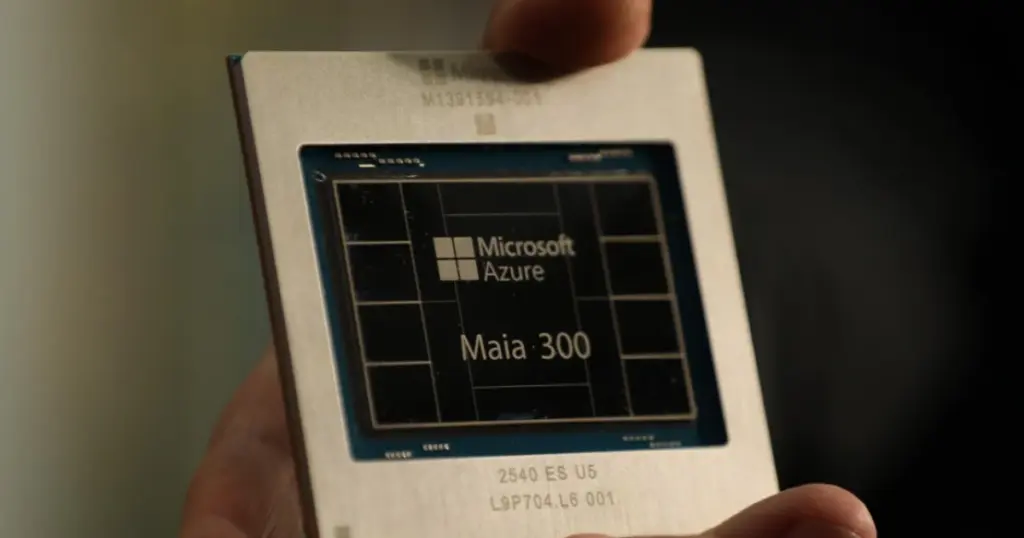
- Microsoft has introduced the Maia 300, its third-generation custom AI accelerator built on a 2nm chiplet architecture.
- The silicon is designed to serve as the primary inference engine across Microsoft’s portfolio of products and cloud services.
- Production deployment within the company’s enterprise infrastructure is scheduled to begin in 2027.
Targeting Cloud Independence
Microsoft has officially revealed its latest in-house silicon, the Maia 300, marking the third generation of the company’s proprietary AI accelerator lineup. Engineered to lessen reliance on Nvidia graphics processors, the new chip is planned to become the cornerstone inference engine powering Microsoft’s widespread services and enterprise platforms.
Architectural Strengths and Workloads
Fabricated using an advanced 2nm chiplet design, Maia 300 focuses heavily on operational efficiency and cloud cost reduction. Microsoft emphasized that the architecture is tailored specifically to meet the intensive demands of modern reasoning models and autonomous agentic workflows.
| Specification / Feature | Details |
|---|---|
| Silicon Generation | 3rd-generation in-house Maia accelerator |
| Process Node | 2nm chiplet-based design |
| Primary Focus | Cloud inference, agentic tasks, reasoning AI models |
| Deployment Timeline | Rolling out in 2027 |
| Strategic Goal | Mitigate reliance on Nvidia GPUs and optimize cloud workloads |
The enterprise rollout for Maia 300 is slated for 2027, giving the technology giant a clear roadmap toward scaling its proprietary hardware foundation across its global data center network.
By developing tailored silicon for high-volume inference, Microsoft is actively reshaping datacenter economics. For enterprises and developers utilizing the ecosystem, this strategic shift promises higher operational efficiency and diversified computing resources away from single-vendor hardware constraints.



We tested early Maia instances for high-throughput inference, and the latency consistency was great compared to shared H100 clusters. That said, tooling support around custom kernels still feels a bit raw compared to CUDA. My advice: keep your pipelines strictly wrapped in ONNX or Triton so switching backends stays painless.