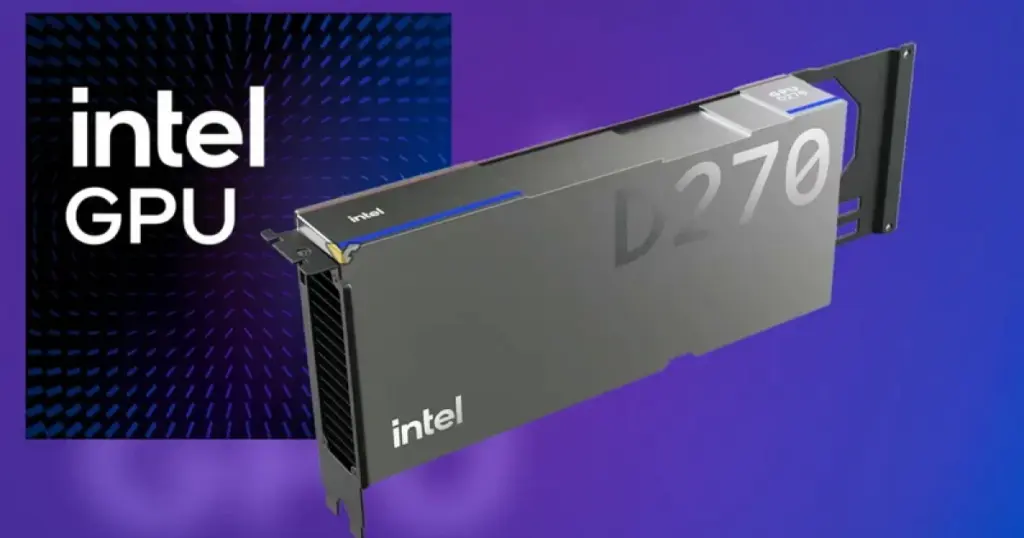
- Intel officially introduced the Intel GPU D-Series at OCP 2026, headed by the GPU D270 accelerator (formerly known as Crescent Island).
- Built on the Xe3P architecture, the PCIe card packs up to 480GB of LPDDR5X memory, delivers 1.3 PFLOPS of FP8 compute, and operates within an air-cooled 350W TDP envelope.
- The hardware eliminates legacy 3D graphics and ray tracing units to target high-concurrency LLM inference for models spanning more than one trillion parameters.
At the Open Compute Project (OCP) 2026 summit, Intel formally christened its enterprise accelerator previously codenamed Crescent Island as the Intel GPU D-Series. Listed on the manufacturer’s official portal as the Intel GPU D270, the device is engineered strictly for artificial intelligence inference rather than graphics or gaming workloads, stripping out traditional rasterization and ray-tracing silicon logic in favor of pure matrix compute.
Xe3P Architecture and the Pivot to LPDDR5X
The GPU D270 marks the production debut of Intel’s Xe3P architecture, turning the compute block into a massively parallel inference engine. Breaking away from costly High Bandwidth Memory (HBM) designs seen on the Gaudi 3 (which featured 128GB HBM), Intel integrated up to 480GB of LPDDR5X memory directly alongside the processor package.
This memory configuration delivers 1.5 TB/s of aggregate memory bandwidth while achieving a peak theoretical performance of 1.3 PFLOPS in FP8 precision. Operating at an enterprise-friendly thermal design power (TDP) of 350W, the card adopts a standard dual-slot PCIe air-cooled form factor, bypassing the infrastructure hurdles and water-cooling demands of hyper-dense clusters.
| Specification | Intel GPU D270 (D-Series) | Intel Gaudi 3 (Predecessor) |
|---|---|---|
| Architecture | Xe3P (Inference-focused) | Gaudi Custom Architecture |
| Memory Type | LPDDR5X | HBM2e / HBM |
| Memory Capacity | Up to 480GB | 128GB |
| Memory Bandwidth | 1.5 TB/s | Multi-terabyte HBM bus |
| Peak FP8 Compute | 1.3 PFLOPS | — |
| TDP / Cooling | 350W (Standard Air Cooling) | Up to 600W–900W (Air / Liquid) |
| Deployment Target | PCIe Server Chassis (Up to 8 GPUs) | OAM / Specialized HGX-style bays |
Enterprise Scalability for Trillion-Parameter Models
Intel highlights that systems equipped with up to eight GPU D-Series cards in a standard air-cooled chassis will be capable of serving inference for models exceeding one trillion parameters. Target use cases encompass long-context retrieval, concurrent multi-tenant APIs, and low-latency robotics workloads.
“Inference is becoming the defining AI workload, and enterprises need infrastructure that delivers the right performance at the right cost,” stated Anil Nanduri, Vice President of AI Products and GTM at Intel. To streamline adoption, Intel relies on its unified Xe software stack, cooperating with OEMs, ODMs, and cloud providers as customer sampling proceeds.
Intel’s strategy trades maximum memory bandwidth for extreme density (480GB) and lower power budgets (350W air-cooled). Data center operators can host massive frontier LLMs without redesigning facilities for liquid cooling. However, sourcing large volumes of LPDDR5X memory for enterprise AI accelerators could further constrict consumer DRAM supply chains.



We tested an early sample in our inference cluster; fitting a huge model without liquid cooling is a game-changer. However, that 1.5 TB/s bandwidth does bottleneck batch-heavy token generation compared to HBM setups. My advice: optimize strictly for high-concurrency API calls with smaller continuous batches to hide memory latency.