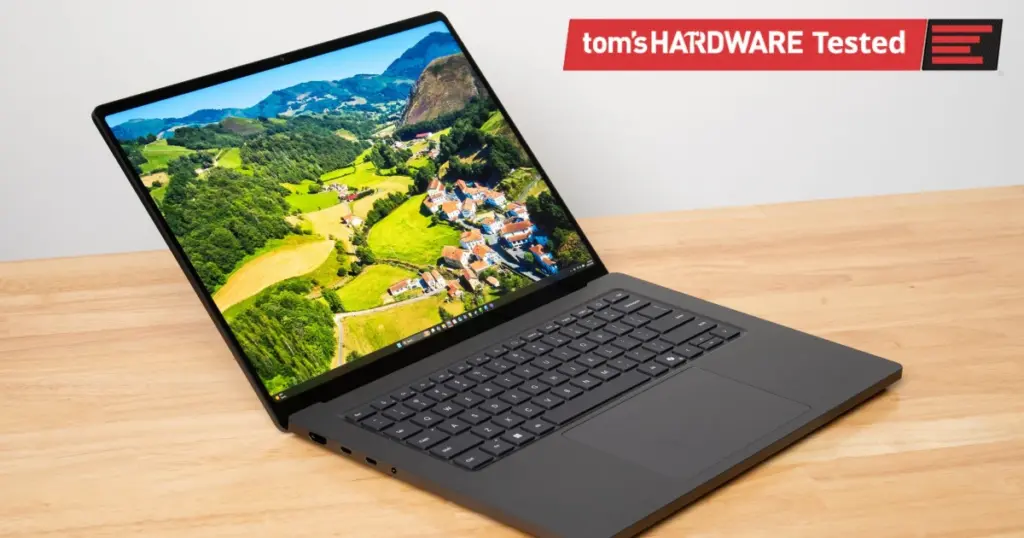
- Nvidia’s all-in-one RTX Spark platform has officially debuted in high-end systems like the Microsoft Surface Laptop Ultra and Asus ProArt P16.
- In local agentic AI benchmarks, the Superchip outperforms Apple’s M5 Max by roughly 25% and doubles AMD Strix Halo’s execution speed.
- Despite sporting 6,144 Blackwell CUDA cores, gaming performance is throttled by 300 GB/s unified memory bandwidth and Prism x86 emulation overhead.
Nvidia’s Strategic Push into PC Silicon
First teased at Computex 2026 by CEO Jensen Huang as a move to “reinvent the PC,” Nvidia’s RTX Spark platform has arrived in commercial hardware. By integrating high-performance Blackwell graphics with an Arm CPU complex and dedicated Windows support, Nvidia and hardware partners including Microsoft, Dell, HP, Asus, MSI, and Lenovo are aiming directly at creator and enterprise workloads. The first systems, including the Microsoft Surface Laptop Ultra and the slim Asus ProArt P16, officially go on sale October 16.
The centerpiece of the platform is the unified memory architecture (UMA), combining up to 128GB of high-speed LPDDR5X-9400 RAM across a 256-bit bus, which can be allocated dynamically to satisfy memory-hungry neural networks.
RTX Spark N1X Hardware Specifications
| Specification | RTX Spark N1X (Base Tier) | RTX Spark N1X (Flagship Tier) |
|---|---|---|
| CPU Architecture | 18 Cores (9x Cortex-X925 + 9x Cortex-A725) | 20 Cores (10x Cortex-X925 + 10x Cortex-A725) |
| CPU Clock Rates | Up to 3.9 GHz (P-core) / 2.8 GHz (E-core) | 4.0–4.1 GHz (P-core) / 2.8 GHz (E-core) |
| GPU Configuration | Blackwell RTX / 40 SMs | Blackwell RTX / 48 SMs |
| CUDA Cores | 5,120 | 6,144 |
| Memory Subsystem | 256-bit, LPDDR5X-9400 | 256-bit, LPDDR5X-9400 |
| Peak Memory Bandwidth | Up to 300 GB/s | Up to 300 GB/s |
| NVLink C2C Bandwidth | 600 GB/s bidirectional | 600 GB/s bidirectional |
| Process Node | TSMC 3 nm | TSMC 3 nm |
| Configurable TDP | 45–80 W | 45–80 W |
Local AI Benchmark: AgentPerf-Local Supremacy
Rather than evaluating isolated token throughput, initial tests utilized Artificial Analysis’s AgentPerf-local suite using custom-compiled llama.cpp builds to mirror real-world agentic multi-turn workloads.
- Dense Model (Qwen 3.8-27B, Q4_K_M): The Surface Laptop Ultra with RTX Spark finished the task approximately 25% faster than Apple’s 14-inch MacBook Pro powered by the top-tier M5 Max (40-core GPU, 18-core CPU). AMD’s Ryzen AI Max+ 395 lagged significantly, taking 40 minutes—double the time required by Spark.
- Mixture-of-Experts (Qwen 3.6 35B A3B): The RTX Spark completed the benchmark run in just 8 minutes, outpacing the 14-inch MacBook Pro (10 minutes) and the Strix Halo desktop rig (13 minutes).
Aided by Microsoft’s 140W thermal envelope and Blackwell’s fifth-generation Tensor cores, the Superchip successfully demonstrated the advantages of unified memory in complex local workflows.
Gaming Analysis: Memory Bottlenecks and Emulation Limits
While the top-tier RTX Spark SoC shares its 6,144 CUDA core count with the desktop GeForce RTX 5070, real-world frame rates align closer to an entry-to-mid mobile discrete GPU. The shared 300 GB/s bandwidth poses a bottleneck compared to dedicated GDDR7 setups (the mobile RTX 5060 alone offers 384 GB/s dedicated to GPU silicon).
| Game & Resolution Preset | Asus ProArt P16 (RTX Spark) | Surface Laptop Ultra (RTX Spark) | Comparison Systems (RTX 5070 Laptop) |
|---|---|---|---|
| Cyberpunk 2077 (1080p, RT Ultra / Very High) | 36 Avg / 27 1% Low | 32 Avg FPS | 43–45 Avg FPS (Framework 16 / Blade 14) |
| Baldur’s Gate 3 (1080p, Ultra) | 42 Avg / 24 1% Low | — | 65–69 Avg FPS |
| Metro Exodus Enhanced (1080p, Ultra) | 75 Avg / 29 1% Low | — | 82–84 Avg FPS |
| Shadow of the Tomb Raider (1080p, Highest) | — | 89 Avg FPS | 109 Avg FPS (Gigabyte Aero X16) |
| Gears of War: E-Day (1908×1272, High, MFG 2X) | — | 77.7 Avg / 39.9 1% Low | 83.5 ms PC Latency (CPU bound) |
CPU-intensive workloads experience noticeable overhead from Windows 11’s Prism x86 emulator. In Gears of War: E-Day, GPU utilization hovered at roughly 85%, with noticeable frame drops. Remedy’s Control Resonant required running in windowed mode at 2560×1440 with DLSS Performance and MFG 3X to hit 109 FPS, though enabling hardware ray tracing triggered severe latency spikes. Additionally, certain titles like Red Dead Redemption 2 failed to launch altogether.
Microsoft Surface Laptop Ultra: Build and Pricing
Microsoft’s flagship chassis features an aluminum unibody weighing 4.41 lbs (2.0 kg), finished in “Nightfall” dark gray. It incorporates a 15-inch PixelSense Ultra Mini-LED touch panel (3270×2180, 24–120Hz), three USB4 ports, HDMI 2.1b, an SD reader, and an upgraded 140W Magnetic Connect adapter. The reviewed configuration with 32GB RAM and a 1TB SSD costs $3,699.99, while entry-level RTX Spark devices start at a steep $2,700 for 24GB of unified memory.
The RTX Spark platform successfully demonstrates that unified Arm-and-Nvidia silicon can beat the best from Apple and AMD in local AI execution. However, with pricing starting at $2,700 and clear performance bottlenecks in legacy x86 gaming titles, it remains a specialized high-performance workhorse for AI practitioners and digital creators, rather than a mainstream gaming laptop replacement.

I’ve been running local 30B models on my Surface Ultra all week, and the inference speed genuinely blows my M-series Mac out of the water. Gaming is definitely rough around the edges due to Prism translation hits, but setting an aggressive 1080p cap with DLSS balanced makes most titles playable.