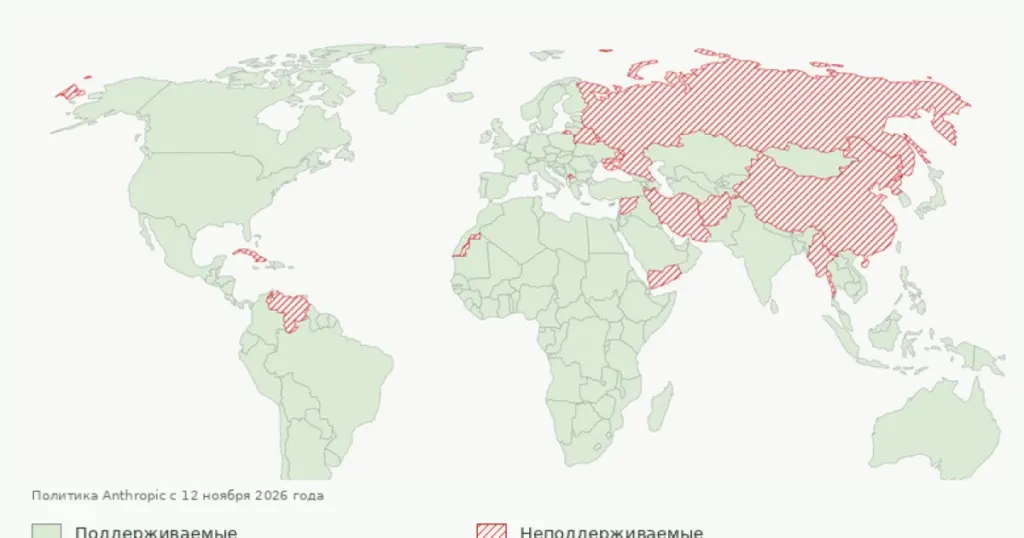
- Anthropic has updated its ‘Supported Regions Policy,’ expanding restrictions on access to Claude products.
- Effective November 12, 2026, the ban applies to companies registered in unsupported jurisdictions and organizations controlled by their residents.
- The changes affect Claude, Claude Code, Cowork, API, and models distributed via cloud platforms and official resellers.
Anthropic, the developer of the Claude AI model, has announced a significant tightening of its ‘Supported Regions Policy.’ These changes, set to take effect on November 12, 2026, extend access restrictions not only to users physically located in unsupported countries but also to organizations registered in such jurisdictions and companies directly or indirectly controlled by their residents.
Expanded Geographic Restrictions
Under the revised policy, an employee of a company from an unsupported region will not be able to use Claude products, even if they are physically located in a permitted country. Similarly, organizations predominantly owned or controlled by individuals and companies from excluded regions will be denied access, even if they are registered in third countries. The reverse rule also applies: an employee of a ‘permitted’ company cannot use the service while in an unsupported country, even during a short business trip.
Affected Products and Services
The new rules encompass a wide range of Anthropic products and services, including:
- Claude.ai
- Claude Code
- Cowork
- API for model access
- Models distributed via cloud platforms and official resellers
Anthropic clarifies that these changes are more of a clarification and reinforcement of previously existing rules rather than the introduction of entirely new prohibitions. The company attributes the tightening to preparations for a potential IPO and the need to ensure revenue compliance with its regional policy.
Key Changes in Access Policy
For clarity, the main aspects of the updated policy are presented in the table below:
| Aspect | Old Policy (Before Nov 12, 2026) | New Policy (Effective Nov 12, 2026) |
|---|---|---|
| Physical Location | Primary restriction | Remains, but supplemented |
| Company Registration Location | Not always a direct factor | Direct restriction factor |
| Corporate Control | Not always explicitly stated | Companies controlled by individuals from unsupported jurisdictions are blocked |
| Employee Citizenship | Not a direct factor | Irrelevant if company or location violates rules |
| Purpose of Changes | Maintain regional policies | Clarification, reinforcement, IPO preparation |
These measures demonstrate Anthropic’s commitment to stricter enforcement of its regional policy, which may impact many international companies and their employees. Such restrictions could lead to a search for alternative solutions for businesses operating under strict geopolitical frameworks. For instance, other major platforms also face regional restrictions, as seen with the widespread Microsoft 365 outage that affected users in various regions.
For companies operating in Anthropic’s unsupported regions or having significant ties to them, access to Claude will become significantly more difficult or impossible. This will necessitate a review of current workflows that utilize Anthropic’s AI models and will likely force them to seek alternative solutions from other providers. Users on business trips will also need to consider these restrictions.



Anthropic’s tightened regional access policy, particularly the November 2026 enforcement targeting corporate registration and control, signals a significant de-risking strategy ahead of a potential IPO. This move aligns with broader industry trends where compliance and geopolitical stability are paramount for market valuation. The implications for multinational enterprises, especially those with distributed teams or complex ownership structures, are substantial, potentially accelerating the adoption of localized AI solutions or open-source alternatives to mitigate operational disruption.