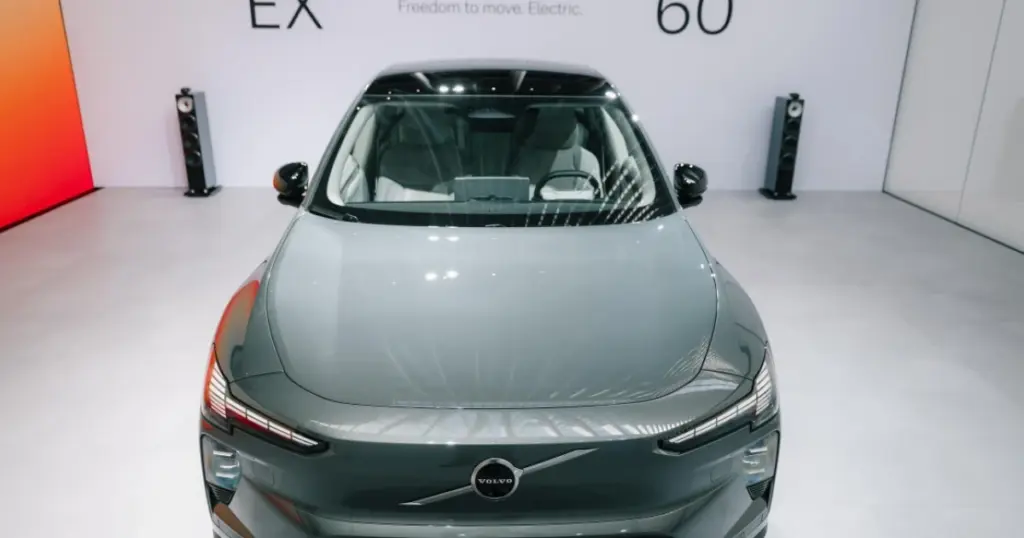
- Volvo Cars and Mercedes-Benz have announced expanded collaborations with Nvidia for the development of next-generation driver assistance and autonomous driving systems.
- Volvo aims to launch hands-free, point-to-point driving (Level 2++) by 2030, powered by Nvidia’s latest AI technology.
- Both automakers will build their future platforms on the same Nvidia self-driving stack, including the Hyperion computer and sensor architecture.
Volvo and Mercedes-Benz Bolster Autonomous Driving Ambitions with Nvidia Collaboration
Leading automotive manufacturers Volvo Cars and Mercedes-Benz have significantly expanded their partnerships with technology giant Nvidia. This collaboration aims to accelerate the development and deployment of next-generation driver assistance and fully automated driving systems across their vehicle lineups.
Volvo Cars Targets Hands-Free Driving by 2030
Volvo Cars, the Chinese-owned, Swedish-designed automaker, has outlined plans to introduce hands-free, point-to-point driving by 2030. This advanced system, which will allow drivers to disengage from active steering, will be powered by Nvidia’s cutting-edge AI technology. Volvo classifies this new point-to-point system as Level 2++, indicating a high degree of partial automation, similar to Tesla’s Full Self-Driving (Supervised) system. The expanded partnership with Nvidia extends beyond Volvo’s current battery electric vehicles, signaling a broader integration of the technology.
Mercedes-Benz Adopts Nvidia for Next-Gen Systems
Mercedes-Benz also announced its commitment to developing its next generation of driver assistance and automated driving systems with Nvidia. This declaration came a day after Volvo Cars’ similar announcement, underscoring a growing trend in the automotive industry towards shared technological platforms. Both carmakers will leverage the same Nvidia self-driving stack, which integrates the Hyperion computer and sensor architecture. This unified platform provides the robust computational power and sensor array necessary for advanced autonomous capabilities, promising a consistent and reliable foundation for future mobility solutions.
The Technological Core: Nvidia Hyperion
A critical component of these partnerships is the utilization of Nvidia’s comprehensive autonomous driving stack, centered around the Hyperion architecture. This platform delivers the necessary processing power and a suite of sensors to manage vast amounts of real-time data, which is essential for autonomous driving systems. Integrating Nvidia’s AI technologies will enable the creation of more sophisticated and adaptive algorithms for navigation, object recognition, and decision-making in diverse driving conditions. NVIDIA is also actively advancing AI solutions for other segments, including local AI capabilities for laptops.
The expanded partnerships between Volvo, Mercedes-Benz, and Nvidia signify an accelerated pace in the development and integration of advanced autonomous driving systems into mainstream vehicles. For consumers, this translates into the potential for safer, more convenient cars capable of partially or fully autonomous travel. For the automotive industry, it highlights an increasing reliance on specialized technology partners like Nvidia, who provide comprehensive hardware and software solutions for the future of mobility. The standardization on Nvidia’s Hyperion platform could also facilitate faster knowledge sharing and reduced development costs for the participating automakers.


The strategic alignment of Volvo and Mercedes-Benz on Nvidia’s Hyperion platform is a significant validation for the compute-centric approach to ADAS/AD. This unified stack, particularly its DRIVE Orin SoC and robust sensor fusion capabilities, provides a scalable architecture essential for progressing beyond Level 2. The 2030 Level 2++ target for Volvo, leveraging Nvidia’s AI, suggests a focus on continuous feature deployment and OTA updates, which is critical for market differentiation and long-term viability in this competitive space.