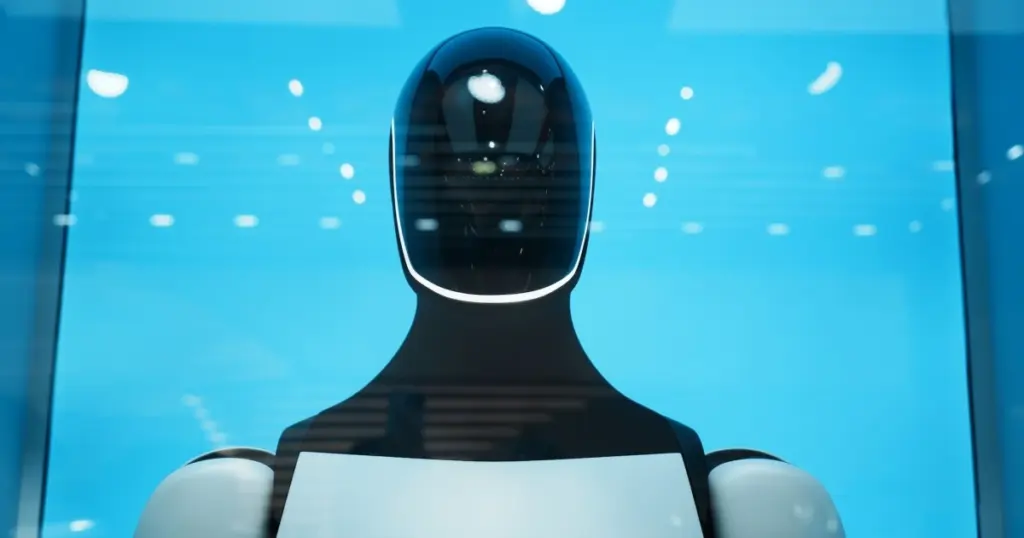
- Tesla has commenced early production of its Optimus humanoid robots at its Fremont, California facility.
- The company’s profit fell by 43% to $787 million in Q3, attributed to substantial investments in AI and robotics.
- Elon Musk likened Optimus’s training to raising a toddler, stating 10,000-20,000 robots are needed for data collection.
Tesla has initiated early production of its Optimus humanoid robots on its high-volume line in Fremont, California. This development coincides with a significant 43% drop in the company’s third-quarter profit, a decline attributed to aggressive spending on artificial intelligence, robotics, and autonomous driving initiatives.
Financial Performance and AI Investments
According to Tesla’s third-quarter update, released on Wednesday, the company’s net income stood at $787 million, a substantial decrease from $1.37 billion reported in the same period last year. Revenue remained flat at $28.05 billion.
| Metric | Q3 Current Year | Q3 Prior Year | Change |
|---|---|---|---|
| Net Income | $787 million | $1.37 billion | -43% |
| Revenue | $28.05 billion | $28.05 billion | 0% |
The stagnant revenue combined with skyrocketing expenses underscores Tesla’s commitment to accelerating its investments in cutting-edge technologies like Optimus, AI, and autonomous driving. This strategic focus on AI mirrors broader industry trends, as evidenced by SK Hynix’s predictions of memory shortages extending to 2030 due to surging AI demand.
Optimus Development: Challenges Ahead
During the company’s third-quarter earnings call on October 21, Tesla CEO Elon Musk elaborated on the development of Optimus. He likened the process of training the robots to raising a toddler, indicating the extensive learning curve required. Musk stated that Tesla needs to build between 10,000 and 20,000 Optimus humanoid robots to gather sufficient training data through practice.
Despite the commencement of production, Musk also outlined several areas still requiring significant work. These include refining the robot’s hands, enhancing its safety, improving reliability and durability, and advancing the artificial intelligence necessary for Optimus to become a truly productive tool.
The initiation of Optimus robot production, even in its early stages and despite significant financial outlay, signals Tesla’s long-term vision for diversifying beyond automotive manufacturing. For consumers and industries, this signifies the potential emergence of new automation solutions for labor. However, the substantial R&D costs and the intricate nature of AI development in robotics suggest that widespread adoption may be a distant prospect, requiring patience and sustained capital investment.


It’s fascinating to see Tesla push into humanoid robotics, especially with the ‘toddler’ analogy for training Optimus. I’m curious about the specific types of data they’re collecting from these initial 10,000-20,000 robots. What kind of ‘practice’ yields the most valuable learning for a general-purpose humanoid, and how do they plan to scale that data collection effectively? Also, how much of the current 43% profit decline is directly attributable to Optimus R&D versus other AI/robotics initiatives? It’d be interesting to unpack that further.