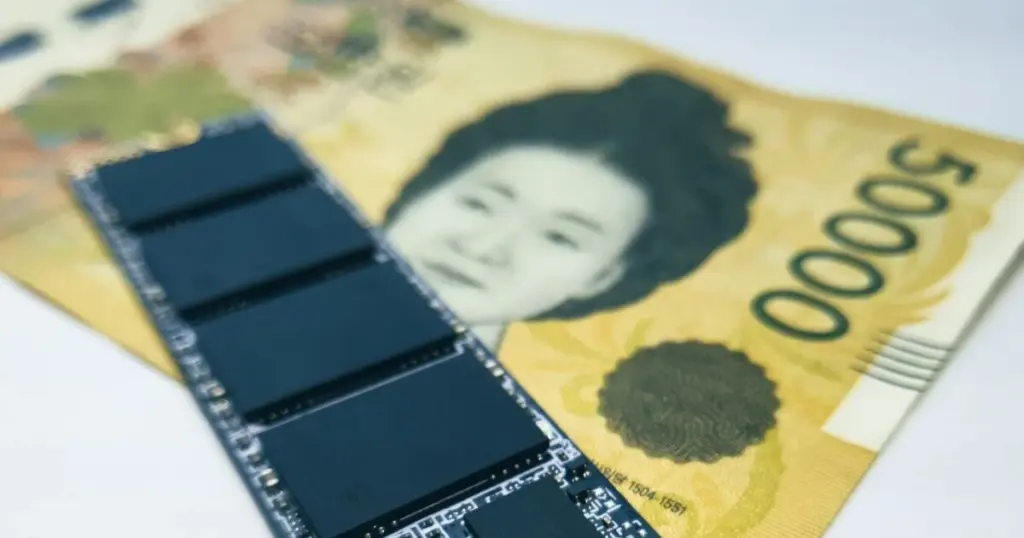
- SK Hynix forecasts that RAM and flash memory shortages will continue until at least 2030.
- The company reported record quarterly revenue of ₩104.6 trillion and operating profit of ₩87.68 trillion, driven by AI memory demand.
- Rising memory prices and shortages are expected to impact PC and mobile device shipment volumes.
SK Hynix: AI-Driven Memory Shortages to Last Until 2030
Korean memory manufacturer SK Hynix has projected that global shortages of RAM and flash memory will persist until at least 2030. This announcement comes alongside the company’s robust quarterly results, which indicate a significant boost in revenue and profits, primarily fueled by the burgeoning demand for AI infrastructure.
According to the company, “a virtuous cycle has taken hold in which AI-driven productivity gains and new revenue generation in areas such as software development, customer service, and search lead to greater AI adoption, which in turn drives increased investment in infrastructure.”
Escalating Demand and Production Constraints
SK Hynix notes that an increasing number of buyers are entering the market for AI infrastructure, including “general enterprises” and nations developing sovereign infrastructure. In the coming years, further demand for memory is anticipated from autonomous vehicles and the expanding robotics market.
Despite the company’s efforts to construct and operationalize new factories, executives acknowledge that the pace is insufficient to meet the escalating demand. “The company assessed that supply … is not keeping pace with the growth of the market,” SK Hynix informed investors. “Given technical difficulty of leading-edge processes and the long lead time required to build new production facilities, it expects the structure in which demand exceeds supply to persist through 2030.”
SK Hynix currently holds 14 long-term agreements with major buyers, who are collectively committed to purchasing over half of its output during 2027 and 2028. These deals incorporate mechanisms that reflect market conditions within an agreed price range, providing SK Hynix with a “structure that secures stable profitability while allowing flexible responses to market changes.”
Financial Performance and Future Outlook
The company reported a record quarterly revenue of ₩104.6 trillion ($78.1 billion), marking a 328 percent increase year-over-year and a 32 percent rise quarter-over-quarter. Operating profit reached ₩87.68 trillion ($62.8 billion), a 486 percent increase from the previous year. This quarter marks the first time the South Korean memory maker’s quarterly sales have surpassed the ₩100 trillion mark.
| Metric | Q3 Current Year | Q3 Previous Year | Change |
|---|---|---|---|
| Revenue | ₩104.6 trillion ($78.1 billion) | ₩24.44 trillion | +328% |
| Operating Profit | ₩87.68 trillion ($62.8 billion) | ₩15.09 trillion | +486% |
SK Hynix plans to expand production and prioritize lucrative products that will “scale up revenue and profit one step further next year.” However, this strategic shift may impact other segments. Chief financial officer Kim Woo-hyun predicted that “shipment volumes for PCs and mobile devices are expected to decrease due to cost burdens from rising memory prices and supply shortages.”
Future plans outlined by the company include:
- Increasing HBM4 production, which is anticipated to “surpass HBM3E in both shipment volume and revenue in the fourth quarter and … establish itself as a mainstream product.”
- “Rapidly” increasing the portion of its 10nm-class 6th generation (1c) process technology and expanding sales of DDR5 and LPDDR5 SOCAMM for AI servers.
- Developing NAND “into a core solution that enhances the throughput and economic efficiency of AI services, based on HBF and system optimization technologies.”
SK Hynix’s forecast underscores the sustained demand for advanced memory driven by the AI boom. For consumers, this implies continued high prices for devices utilizing RAM and flash memory, alongside potential reductions in the availability of PCs and mobile devices. For electronics manufacturers, it highlights the critical need for long-term component supply planning and potential adjustments to pricing strategies. Investors, meanwhile, view this outlook as a confirmation of robust growth within the AI and semiconductor sectors.


I’ve been feeling this memory crunch acutely, especially trying to upgrade my home server. DDR5 prices are just wild, and finding specific high-capacity ECC modules is like a treasure hunt. It’s frustrating because I want to expand my AI model training capabilities, but the cost-to-performance ratio for RAM right now makes it hard to justify. My tip: if you’re building, try to future-proof with slightly higher capacity modules than you think you need, even if it hurts the wallet a bit now. Swapping later might be even worse.