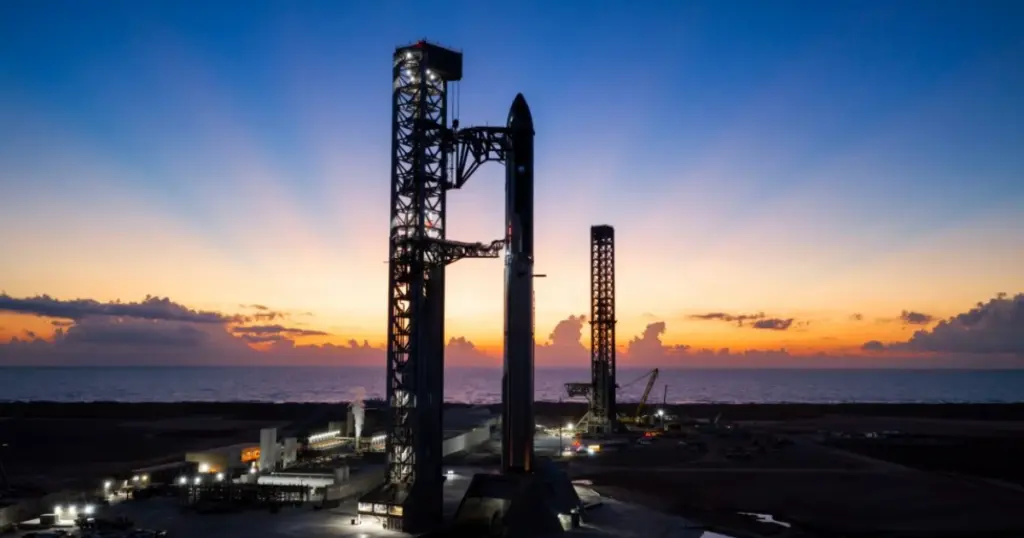
- NASA has detailed updated Artemis program plans, aiming for astronaut lunar landings by 2028, with significant architectural changes.
- Estimates for Starship launches required for lunar lander refueling are contentious: NASA suggests around 22, while Elon Musk claims 6-8.
- The revised plan includes Orion docking with Starship in high-Earth orbit and four New Glenn launches for Blue Origin without in-space refueling.
NASA Outlines Revised Artemis Program Architecture and Timeline
NASA has provided a detailed overview of its updated plans to return astronauts to the lunar surface as part of the Artemis Program, targeting a landing date as early as 2028. These updates include substantial changes to the mission architecture.
For SpaceX’s Starship vehicle, the revised plan calls for the Orion spacecraft to dock with the Starship lunar lander in high-Earth orbit before transiting to the Moon. For Blue Origin, the mission architecture includes four launches of the New Glenn rocket, notably without requiring spacecraft-to-spacecraft refuelings. Additionally, Blue Origin’s plans allow for the possibility of its Blue Moon lander rendezvousing with Orion in low-Lunar orbit.
Dispute Over Starship Refueling Launch Estimates
A central, and often guarded, metric within the Artemis Program is the number of Starship launches required to fuel a Starship-based lunar lander in low-Earth orbit, enabling it to fly to the Moon, land, and return to lunar orbit. This number has been a moving target, with NASA’s general response typically being, “We don’t know for sure, so we’re not going to say.”
Recently, NASA’s safety watchdog, the Aerospace Safety Advisory Panel (ASAP), suggested that approximately 22 launches might be needed to support a landing by the Human Landing System (HLS) variant of Starship on the Moon. However, SpaceX CEO Elon Musk quickly disputed this figure on X, stating, “That’s way too high. Actual number will be more like 6 to 8.”
In contrast to the Apollo program, where a single Saturn V launch was sufficient to send a fully fueled Lunar Module to the Moon, the US lunar landers being developed for Artemis require in-space refueling. This necessitates additional launches to deliver propellant before astronauts can head to the surface. The primary challenge lies in demonstrating reliable transfers of cryogenic propellant between spacecraft at the scale these heavier, more complex landers demand. Apollo’s Lunar Module, for instance, used hypergolic propellants, which do not require cryogenic storage.
Artemis Program Outlook and Challenges
Even with the rescoping that made Artemis III a low Earth orbit demonstration of lunar technologies from Blue Origin and SpaceX in 2027, the Artemis program remains ambitious. SpaceX has, to date, managed one Starship test flight to orbit. If the launch figure cited by the panel is accurate, Musk’s rocketeers face a challenging road ahead.
Concerns Regarding ISS Access and Commercial Redundancy
ASAP also raised concerns about future access to low Earth orbit. SpaceX’s plans to phase out Falcon rockets and Dragon spacecraft could complicate any extension of International Space Station (ISS) operations and the launch of its deorbit vehicle. This also highlights a broader issue of commercial redundancy, as major systems often require robust backup options. Boeing’s Starliner, now projected for an uncrewed launch no earlier than mid-January 2027, could become the sole commercial option for astronaut transport to the ISS if Dragon operations end, a situation NASA had hoped to avoid.
| Parameter | NASA/ASAP Estimate | Elon Musk’s Estimate | Apollo (for comparison) |
|---|---|---|---|
| Starship Launches for Lunar Mission | ~22 | 6-8 | 1 (Saturn V for Lunar Module) |
| In-Space Refueling Required | Yes (Cryogenic Propellant) | Yes (Cryogenic Propellant) | No (Hypergolic Propellants) |
| Propellant Type | Cryogenic | Cryogenic | Hypergolic |
NASA’s updated plans and the ongoing debate surrounding the number of Starship launches underscore the inherent complexities and ambitious nature of returning humans to the Moon. The significant disparity in launch estimates highlights the technical and logistical hurdles associated with in-space cryogenic refueling. The success of the Artemis program will largely depend on the ability of SpaceX and Blue Origin to meet their stated objectives, alongside addressing broader challenges concerning reliable access to low Earth orbit and the ISS, which are critical for the entire space industry.


The discrepancy between NASA’s 22 Starship launches and Elon Musk’s 6-8 for refueling is fascinating. It really highlights the unknown territory of cryogenic propellant transfer at this scale. I wonder how much of that difference comes down to varying assumptions about transfer efficiency versus actual propellant mass needed. Also, what are the implications for the overall mission timeline if Musk’s estimates prove overly optimistic?