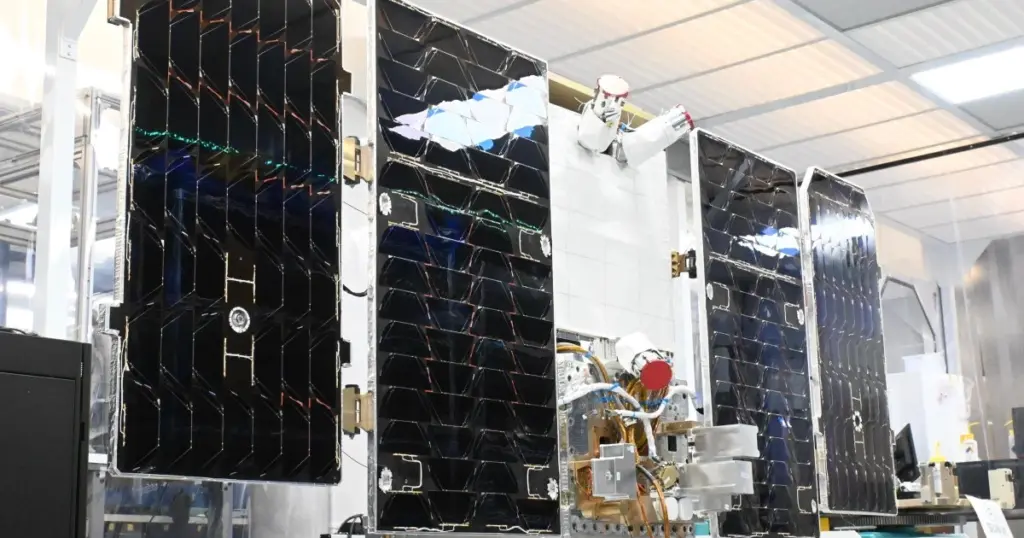
- Google successfully tested its Tensor Processing Units (TPUs) aboard the Suncatcher satellite in Earth’s orbit.
- The onboard Gemma 4 AI model generated a haiku about being in space in response to a ground station prompt.
- This marks a significant step in orbital computing, potentially leading to more cost-effective data centers in the future.
Google Activates AI in Orbit
Google has announced the successful activation and testing of its Tensor Processing Units (TPUs) aboard its first experimental orbital AI datacenter satellite, dubbed Suncatcher. Launched at the beginning of the month and placed into low Earth orbit, the satellite successfully completed its initial prompt, generating a response using the onboard Gemma 4 artificial intelligence model.
Travis Beals, senior director of Google’s interdisciplinary Paradigms of Intelligence research team, confirmed that with Suncatcher’s host and TPU trays powered up and machine learning tests completed, the Gemma 4 model achieved its “Hello World” milestone. This occurred during a ground-station pass over Svalbard, Norway, when the orbiting AI model transmitted its inference response.
The First “Space” Haiku
The AI’s inaugural task was to “Write a haiku from the perspective of a TPU orbiting Earth, with the wonderful world spinning beneath you.” Gemma 4’s response was:
- Blue marble below,
- Data streams in silent grace,
- Starlight feeds my core. ✨
These approximately 20 tokens, if generated through the Google Cloud API, would cost about $0.000012, based on Gemma 4 26B’s pricing. However, considering a satellite weighing perhaps 500 kg (similar to SpaceX’s Starlink satellites) and a retail launch price of around $7,000 per kg, this haiku was a very expensive one.
Economic Prospects and Future Tests
Google predicts that by 2035, the cost of getting a satellite into low Earth orbit could be brought down to $200/kg. At this rate, the launch cost amortized over the satellite’s useful life (approximately $810-7,500/kW/year) could be comparable to current electricity spending for terrestrial data centers in the US (approximately $570-3,000/kW/year). The company considers it strategically beneficial to prototype well in advance of this becoming a reality.
Following the haiku, tests were conducted for space-themed limericks and telemetry prompts reporting the technical status of the payload systems. The next phase will involve evaluating how TPUs perform under thermal stress and radiation. Google has already conducted laboratory testing of its Trillium Cloud TPU and AMD host server to assess their resilience against a 67 MeV proton beam. The system’s high-bandwidth memory showed the most sensitivity to the total ionizing dose, exhibiting irregularities after a cumulative dose of 2 krad(Si), which is about 3× Google’s minimum requirement for TID survival of 750 rad(Si).
| Parameter | Value / Description |
|---|---|
| Satellite | Suncatcher (experimental orbital data center) |
| Launch Date | October 1 |
| AI Model | Gemma 4 |
| Orbit | Low Earth Orbit (LEO) |
| Processors | Tensor Processing Units (TPUs) |
| Cost of 20 tokens (API) | ~0.000012 USD |
| Projected Launch Cost (2035) | 200 USD/kg |
| Current Launch Cost | ~7000 USD/kg |
Google researchers noted that for typical transformer workloads, the observed silent data corruption (SDC) rate of approximately one event/17 rad, at an estimated orbital dose of 150 rad(Si)/year, translates to a very low failure probability on the order of 1 per 3 million inferences (assuming 1 inference per second). While this error rate is likely acceptable for inference, the impact of single-event effects (SEEs) on training jobs and the efficacy of system-level mitigations require further study.
The study will continue, with plans next year to test a pair of interconnected satellites. Rather than lofting large satellites into orbit, Google anticipates sending a constellation of many smaller satellites that communicate with one another. This approach aligns with broader trends in distributed systems and could revolutionize how data centers operate, much like how AI agents are transforming software development.
The successful deployment and testing of AI computing in orbit open new frontiers for cloud services and distributed computing. This could lead to more resilient and, in the long term, more cost-effective data centers located beyond Earth’s atmosphere. For developers, it implies a potential expansion of infrastructure for resource-intensive AI tasks, and for the industry, a significant reduction in reliance on terrestrial constraints such as electricity and cooling costs, once launch expenses become more favorable.


This successful orbital deployment of TPUs and Gemma 4 marks a pivotal moment, shifting from theoretical discussions to practical implementation of space-based computation. The focus on radiation resilience, particularly the 2 krad(Si) TID sensitivity in HBM, highlights critical engineering challenges for long-duration missions. While the haiku’s cost is amusingly high today, the projected $200/kg launch costs by 2035 could fundamentally alter the economics of distributed data processing, especially for latency-sensitive applications in remote regions or for scientific data acquisition.