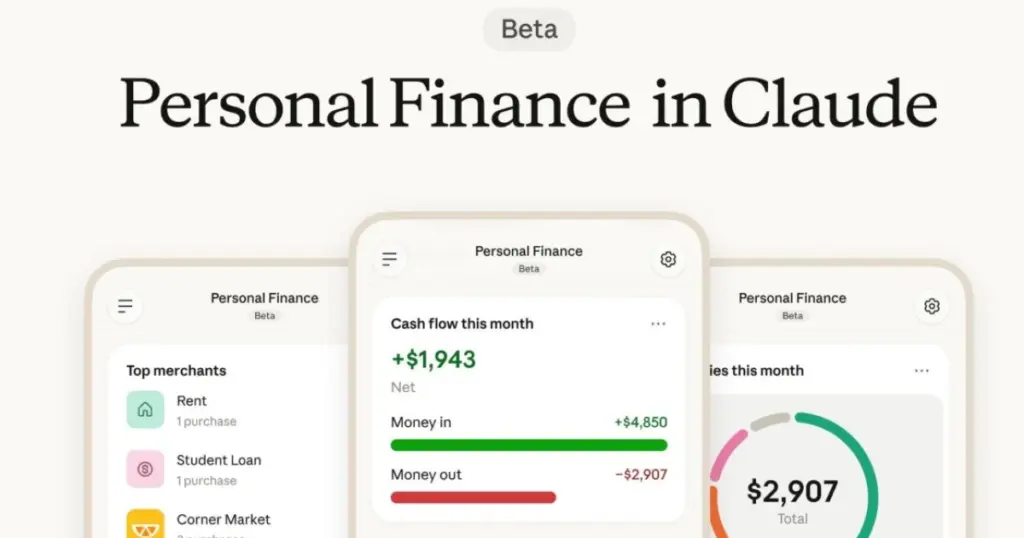
- Anthropic has launched a new Personal Finance feature for its Claude AI assistant.
- This feature enables Claude to connect to users’ bank and card accounts via the Plaid platform for spending analysis.
- The tool operates in a “read-only” mode, explicitly preventing any financial transactions.
Claude Enhances Financial Analysis Capabilities
Anthropic, a leading artificial intelligence developer, has introduced a new Personal Finance feature for its Claude chatbot. This update allows users to directly link their bank and card accounts to the AI through the Plaid bank bridging platform. The primary objective of this feature is to empower Claude to analyze personal finances and answer queries, such as “where did my money go this month.”
Plaid Integration for Secure Access
The integration with Plaid ensures a secure connection to financial institutions. Anthropic emphasizes that the Personal Finance feature is strictly “read-only.” This means Claude can view transactions and balances to generate overviews and respond to inquiries but lacks the capability to initiate any financial actions, such as transfers or payments. This measure is designed to safeguard user data and prevent unauthorized operations.
Competition in the AI Finance Market
The launch of Anthropic’s Personal Finance can be seen as a strategic move in response to similar AI initiatives, including those observed with ChatGPT. Providing relevant data context is crucial for enhancing the utility of AI tools, and the ability to securely utilize personalized financial data significantly expands Claude’s analytical prowess.
As AI tools like Claude and Gemini evolve, companies are striving to integrate them into users’ daily lives. For instance, Google recently restricted access to Gemini models, highlighting the dynamic development and regulation within this sector.
For users, this signifies the availability of a powerful tool for obtaining detailed reports on their spending and financial behavior without the need for manual data aggregation. Claude can help identify spending trends, provide summaries by expense category, and answer specific questions about fund movements. However, as with any AI tool handling sensitive data, users should carefully evaluate the risks and benefits of connecting their financial accounts.



While the read-only mode is a reassuring detail, connecting an AI directly to bank accounts, even through Plaid, still raises significant privacy and security concerns. We’re entrusting a third-party AI with an incredibly intimate view of our financial lives. What are the long-term implications for data aggregation, potential breaches, or even subtle biases in the AI’s financial advice based on this access? The convenience is clear, but the potential downsides feel understated.