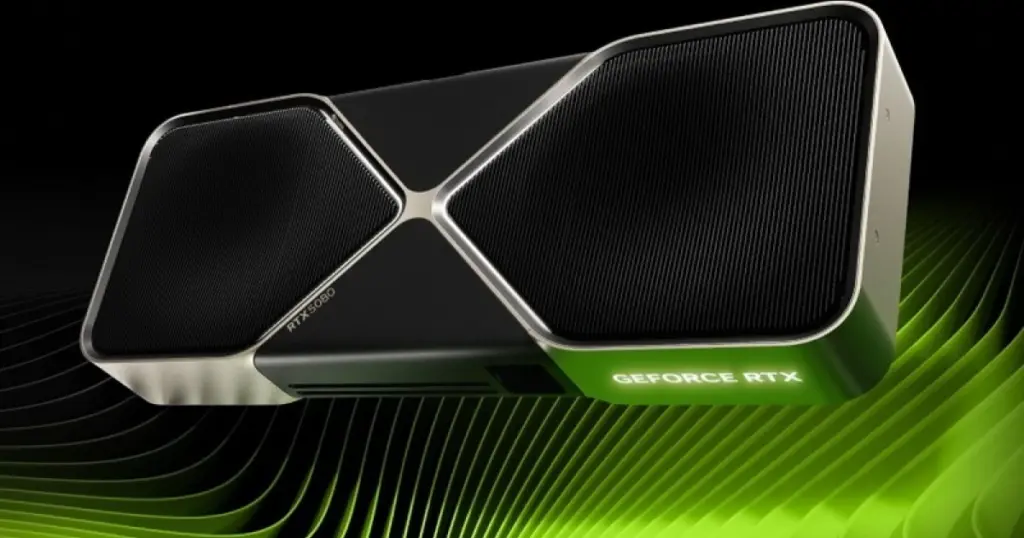
- Nvidia’s GeForce RTX 5080 is now selling at prices comparable to the RTX 5090’s launch MSRP, with costs nearing $2,000 and beyond.
- Nvidia has removed the RTX 5080 from its official online store, mirroring the RTX 5090’s disappearance and fueling rumors of production halts to prioritize AI enterprise solutions.
- Limited stock and increased demand, partly driven by the AI sector’s need for high-end GPUs and HBM, have led to significant price hikes in the retail market.
GeForce RTX 5080 Prices Skyrocket to RTX 5090 Launch Levels
The Nvidia GeForce RTX 5080, Nvidia’s second-fastest GPU in its current generation, is experiencing an unprecedented price surge. Nearly two years post-launch, acquiring this graphics card at its original Manufacturer’s Suggested Retail Price (MSRP) of $999 is virtually impossible. Retail prices in the U.S. have now reached a minimum of $1980, aligning with the RTX 5090’s launch MSRP. Certain versions of the RTX 5080 are fetching even higher prices, up to $2983.23.
For instance, a PNY RTX 5080 is available at Best Buy for $1999. More premium options include the Asus ROG Astral mode at Newegg for $2299.99, and a Gigabyte RTX 5080 from MemoryC priced at $2983.23. Micro Center also lists a Gigabyte card for $1979.99, depending on location. A significant portion of available stock is from third-party sellers, such as a PNY RTX 5080 on Amazon priced at $2211.17.
Nvidia’s Official Store Removes RTX 5080 Listing
Following the GeForce RTX 5090, the GeForce RTX 5080 has also been removed from Nvidia’s official U.S. online store. This action raises questions regarding its status and future availability, especially since other Blackwell SKUs like the GeForce RTX 5070 Ti and GeForce RTX 5070 remain listed, albeit marked as “Out of Stock.” The complete removal of the RTX 5080 and RTX 5090 breaks this pattern, fueling speculation that Nvidia may have ceased their production.
Rumors suggest Nvidia might have halted RTX 5090 production to repurpose the valuable GB202 silicon for its RTX Pro Blackwell lineup, which yields higher margins. This aligns with the perception that Nvidia’s focus has increasingly shifted towards being an AI provider rather than solely a gaming hardware vendor.
Factors Driving Scarcity and Price Hikes
The escalating prices and limited availability of the GeForce RTX 5080 are attributed to several factors. While demand for high-end GPUs persists, Nvidia’s attention has largely pivoted to the enterprise AI market. This shift has also impacted memory manufacturers, diverting DRAM allocations and production lines that would typically supply memory chips for consumer graphics cards towards high-margin HBM for AI data centers. Consequently, the RTX 5080’s prices have surged to two to three times its original MSRP due to this significant supply constraint.
Nvidia GeForce RTX 5080 Specifications:
| Parameter | Value |
|---|---|
| GPU | Nvidia GB203 |
| CUDA Cores | 10,752 |
| VRAM | 16GB GDDR7 |
| Launch MSRP | $999 |
| Current Price (min.) | $1979.99 |
There are rumors that Nvidia may introduce a GeForce RTX 5080 24GB as the new flagship gaming graphics card. While a 24GB variant would address one of the primary consumer concerns regarding memory capacity, it would not be a direct replacement for the RTX 5090. The rumored 24GB variant would feature half the CUDA cores of the RTX 5090, creating a substantial performance gap that even a 50% memory increase cannot bridge.
For gamers and PC enthusiasts, the current market for the GeForce RTX 5080 presents significant challenges in terms of cost and availability. Prices have surpassed the original MSRP of the flagship RTX 5090, and stock is severely limited. This situation reflects a broader market trend where the burgeoning demand for GPUs from the AI industry is diverting resources away from the consumer segment. The potential release of an RTX 5080 24GB might offer more memory, but it is unlikely to alleviate immediate pricing and scarcity issues, nor will it fully compensate for the performance capabilities of the RTX 5090.



The soaring prices of the RTX 5080 are certainly concerning, but I wonder how much of this is pure scarcity versus opportunistic pricing by third-party sellers. While the article points to Nvidia’s shift to AI, it’s hard to believe they’d completely abandon such a key consumer segment. Perhaps it’s a strategic move to clear inventory for a new generation, rather than a full pivot. Consumers are left footing a very steep bill in the meantime.