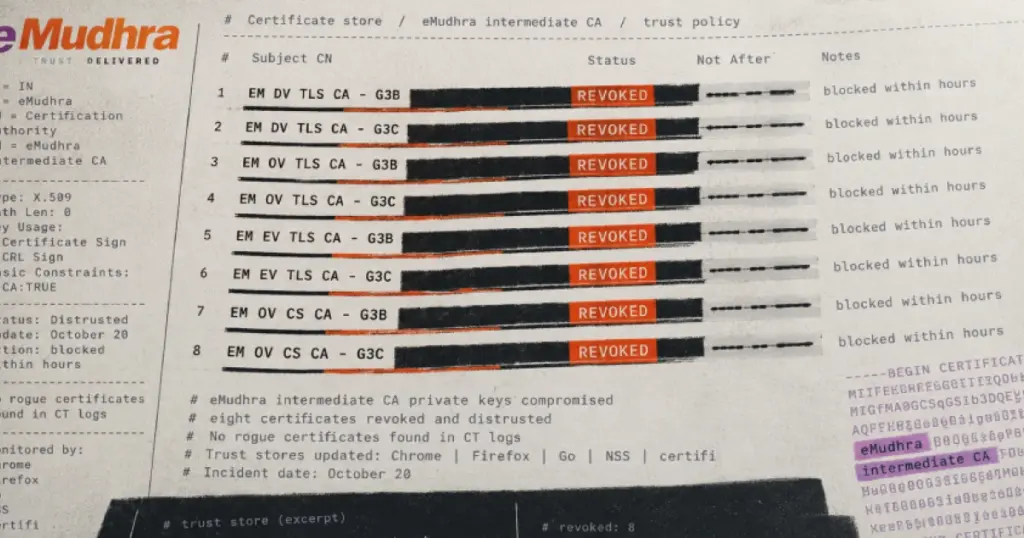
- Eight intermediate TLS certificate authority keys belonging to India-based eMudhra have been compromised worldwide.
- Security researchers revealed absurdly weak generation: private keys were trivial integers such as 4, 56, and 115, recoverable in under a second.
- Major browser vendors including Mozilla, Google, and Apple have deployed urgent mitigations, but legacy embedded systems and Linux hosts face extended clean-up cycles.
Critical Infrastructure Vulnerability at eMudhra
Global cybersecurity defenses have entered a state of high alert following an unprecedented failure in public key infrastructure. India-based certificate authority eMudhra, an entity that highlights issuing over 60 million digital certificates globally, suffered a catastrophic compromise affecting eight intermediate CA certificates. The incident was formally acknowledged by Mozilla and Google’s Chrome Root Program.
Intermediate CAs hold the authority to sign downstream TLS certificates for web servers. An unauthorized party possessing these private keys could generate fully trusted certificates for any domain across the internet, enabling comprehensive Man-in-the-Middle (MitM) interception and malicious traffic modification without triggering browser security warnings.
The Number 4: Anatomy of a Cryptographic Breakdown
The issue came to light when an informal advisory appeared on the domain emudhra.we-have-a-problem.com with the text “We have a problem here - Wayne,” authenticated via a valid signature from one of eMudhra’s intermediate keys. Dennis Jackson of Mozilla’s cryptography engineering team confirmed that Mozilla received notification from a community member on Saturday, October 17, at 20:06 UTC.
Subsequent technical inspection by security researcher Scott Helme unveiled a staggering lapse in basic entropy. While a standard P-384 private key requires a random 384-bit integer providing approximately 10115 search combinations, eMudhra’s keys were shockingly simple low-value integers.
| Parameter | Cryptographic Standard (P-384) | Observed eMudhra Implementation |
|---|---|---|
| Key Entropy / Search Space | 384-bit random number (~2384 / 10115) | Trivial integer values (brute-forceable in milliseconds) |
| Identified Private Key Values | Cryptographically secure pseudorandom sequence | 4, 56, 66, 115, 155, 156, 230, 237 |
| Recovery Time from Public Cert | Practically impossible with modern compute | Under one second on a commodity laptop |
| CA Impact Footprint | Strict HSM key generation & isolation | Over 60 million digital certificates claimed by CA |
Emergency Mitigation and Remediation Efforts
To date, Certificate Transparency (CT) monitors have not identified malicious in-the-wild exploitation of the affected intermediate keys. Engineering teams at Google, Mozilla, and Apple moved quickly to distrust and blacklist the eight intermediate certificates across Chrome, Firefox, and Safari updates. Concurrently, eMudhra initiated certificate revocations, and several open-source ecosystems published fast-tracked updates to purge reliance on the tainted keys.
Despite aggressive responses by desktop browser vendors, widespread remediation across server fleets, Internet-of-Things (IoT) appliances, and embedded Linux distributions presents substantial operational hurdles, as these environments lack automated zero-day certificate root updates.
End users should promptly verify that their web browsers and mobile operating systems are patched to their latest releases. System administrators and DevOps engineers must audit trust stores, container base images, and embedded network appliances to ensure intermediate certificates from eMudhra are explicitly revoked or excluded from their trust anchors.


We had to audit our legacy Ubuntu boxes immediately after reading this, and tracking pinned bundles was a nightmare. Automated browser revocations are fine, but Linux ca-certificates packages take way longer to catch up. A practical tip: run a fast custom script against /etc/ssl/certs with openssl to block these specific intermediates locally instead of waiting on upstream distro patches.