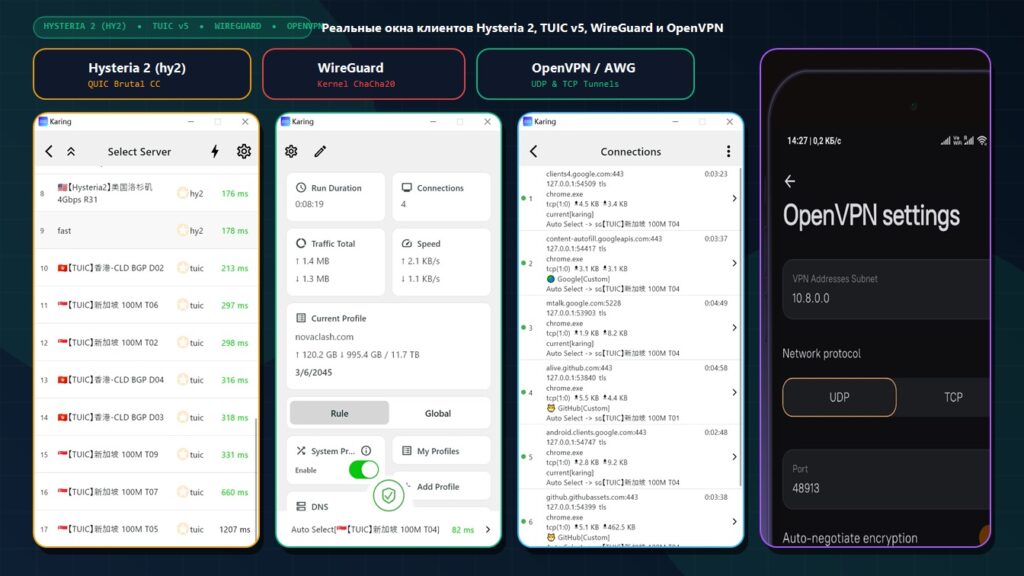
The widespread adoption of HTTP/3 over QUIC (RFC 9000) has fundamentally reshaped enterprise network transport design. While legacy TCP tunnels suffer from TCP-over-TCP Meltdown on lossy wireless, satellite, or congested intercontinental links, modern protocols such as Hysteria 2, TUIC v5, ShadowTLS v3, and kernel-accelerated OpenVPN DCO (Data Channel Offload) address packet delivery through distinct architectural paradigms. Here is our 2026 engineering benchmark and comparison.
- Eliminating TCP-over-TCP Meltdown: Encapsulating TCP inside an outer TCP tunnel causes stacked retransmission timers to collide under 1–3% packet loss, collapsing throughput.
- Hysteria 2 (HTTP/3 QUIC + Brutal CC): Operates over standard RFC 9000 QUIC frames masquerading as an HTTP/3 web server and uses the optional Brutal Congestion Control algorithm to sustain target bitrates on high-loss LTE/5G and satellite links.
- TUIC v5 (0-RTT QUIC Multiplexing): Leverages native QUIC streams and unreliable datagrams (RFC 9221) with Google BBRv3 congestion control for ultra-low-latency VoIP and VDI traffic.
- OpenVPN 2.6/2.7 Kernel DCO: Moves data-channel AES-GCM / ChaCha20 encryption into the OS kernel (
ovpn-dco), boosting throughput up to 2.5–4.2 Gbps.
1. Comparative Benchmark Table: 6 Enterprise Network Protocols (2026)
| Protocol | Base Transport | Congestion Control | Throughput @ 0% Loss (1 Gbps Link) | Throughput @ 3% Loss & 120 ms RTT | Primary Enterprise Use Case |
|---|---|---|---|---|---|
| Hysteria 2 | UDP / QUIC (HTTP/3) | Brutal CC / BBR | 910–940 Mbps | 780–850 Mbps | Lossy LTE/5G field terminals, satellite & high-BDP links |
| TUIC v5 | UDP / QUIC (0-RTT) | BBRv3 / CUBIC | 920–945 Mbps | 540–620 Mbps | Low-latency VDI/RDP, VoIP, real-time telemetry |
| AmneziaWG 3.1 / WireGuard | UDP (L3 TUN) | Inner TCP CC | 955–970 Mbps | 490–580 Mbps | Data center site-to-site interconnects |
| VLESS + XTLS-Vision | TCP / TLS 1.3 | OS TCP BBR | 930–955 Mbps | 380–460 Mbps | Restricted networks where UDP is blocked |
| OpenVPN 2.6+ DCO | UDP / TCP (Kernel DCO) | Inner TCP CC | 880–920 Mbps | 340–420 Mbps | Enterprise remote access with centralized PKI & LDAP/2FA |
| IPSec IKEv2 (StrongSwan) | UDP 500/4500 / ESP | Inner TCP CC | 940–965 Mbps | 450–530 Mbps | Hardware routers (Cisco, MikroTik, Keenetic) & native OS clients |
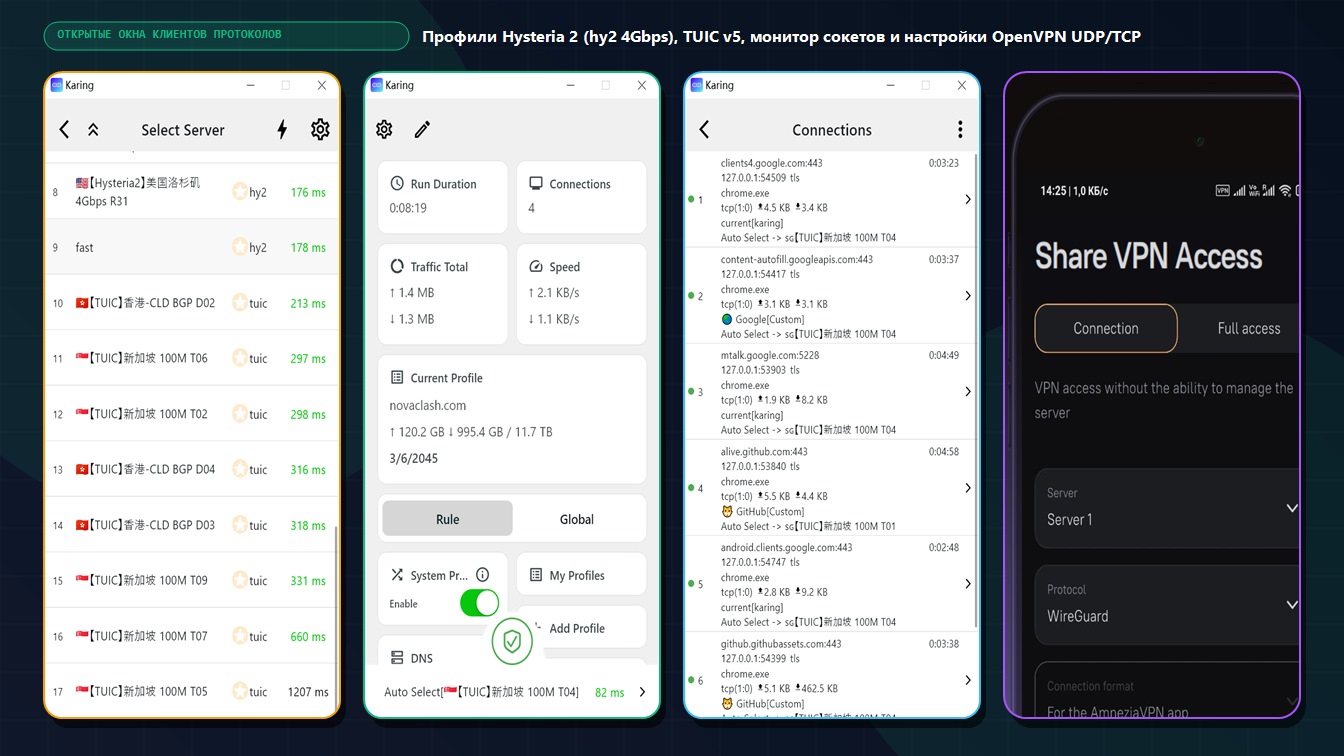
2. Hysteria 2 (QUIC Brutal CC) & OpenVPN 2.6 Kernel DCO Configuration Analysis
In real-world enterprise deployments, administrators pair QUIC-based edge relays (configured with Brutal Congestion Control and the optional Salamander XOR scrambler for high-loss mobile links) with kernel-level OpenVPN 2.6+ DCO (ovpn_dco_v2) or AmneziaWG 3.1 for low-overhead data center interconnects.
Frequently Asked Questions (FAQ)
Why does TCP-over-TCP perform poorly on lossy connections?
When both the outer tunnel and inner connection run TCP congestion control simultaneously, a single dropped packet triggers competing retransmission timers and congestion window reductions across both layers.
How does OpenVPN DCO achieve multi-gigabit speeds?
The ovpn-dco kernel module processes data-channel encryption directly inside the operating system kernel network stack, eliminating costly userspace context switches per packet.
- AmneziaWG 3.1 Protocol & Amnezia 5.0.1.5 Architecture Research: WireGuard Header Randomization and Enterprise Tunnel Protection Against DPI Fingerprinting
- CSQTT Architecture Research (Rust / TURN / RTP): Multi-Stream Traffic Encapsulation in WebRTC Media Relays and Network Dispatcher Analysis
- VLESS Protocol & XTLS Reality Architecture: Cryptographic Analysis of TLS 1.3 Handshake, Active Probing Defense, and Zero-Overhead Vision Flow
- Comparative Analysis of Modern Network Transport Protocols (2026): Hysteria 2 (QUIC), TUIC v5, ShadowTLS v3, WireGuard, and OpenVPN DCO in Enterprise Networks (Current Article)
- DPI Traffic Analysis Technologies & TCP/TLS Packet Fragmentation Optimization: Architectural Breakdown of Zapret (nfqws) and ByeDPI from a Network Engineering Perspective



The benchmark data accurately reflects the shift toward RFC 9000 primitives in enterprise edge design. While Hysteria 2’s Brutal CC shines across satellite topologies, operators must note that sustained aggressive throughput without fair queuing can trigger upstream carrier throttling. In zero-trust SD-WAN deployments, TUIC v5’s native multiplexing remains the more balanced transport layer choice.