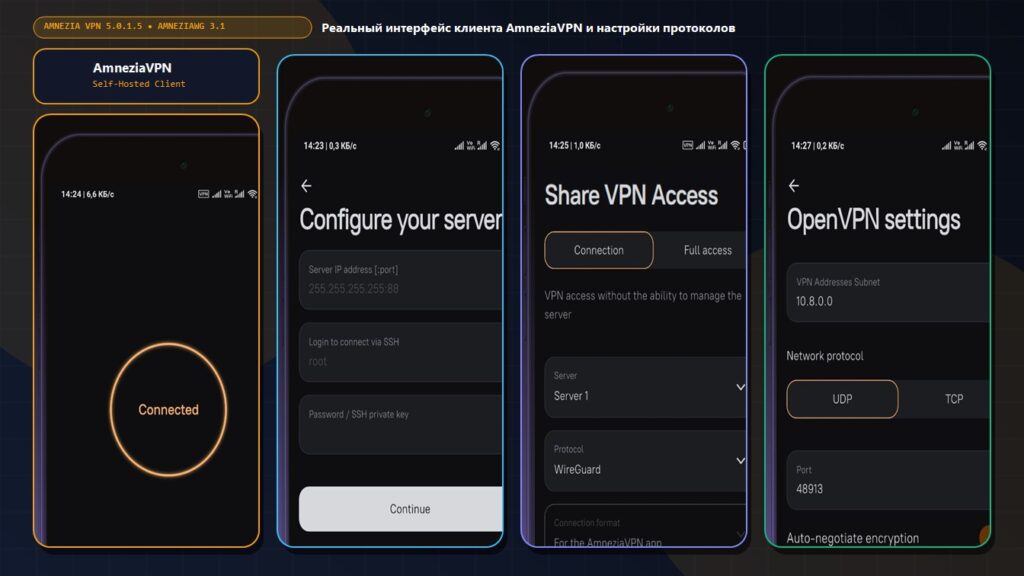
Classic WireGuard revolutionized enterprise cryptography with its concise codebase and high-speed ChaCha20-Poly1305 kernel-space encryption. Yet from the standpoint of network steganography and defending corporate links against traffic fingerprinting, baseline WireGuard has a fundamental architectural trait: deterministic fixed-length headers. In this engineering deep dive, we examine the architecture of the open-source Amnezia 5.0.1.5 stack and the evolution of the AmneziaWG 3.1 transport protocol—from dynamic Magic Header ranges to statistical packet entropy smoothing.
- Why Baseline WireGuard Is Easily Fingerprinted: A static 4-byte message type header (
0x01..0x04) and rigid handshake payload sizes (148 bytesfor Handshake Initiation and92 bytesfor Handshake Response) allow DPI/NGFW engines to classify a tunnel on the very first UDP packet. - AmneziaWG 3.1 Protocol Advances: Moves from static constants to dynamic header ranges (
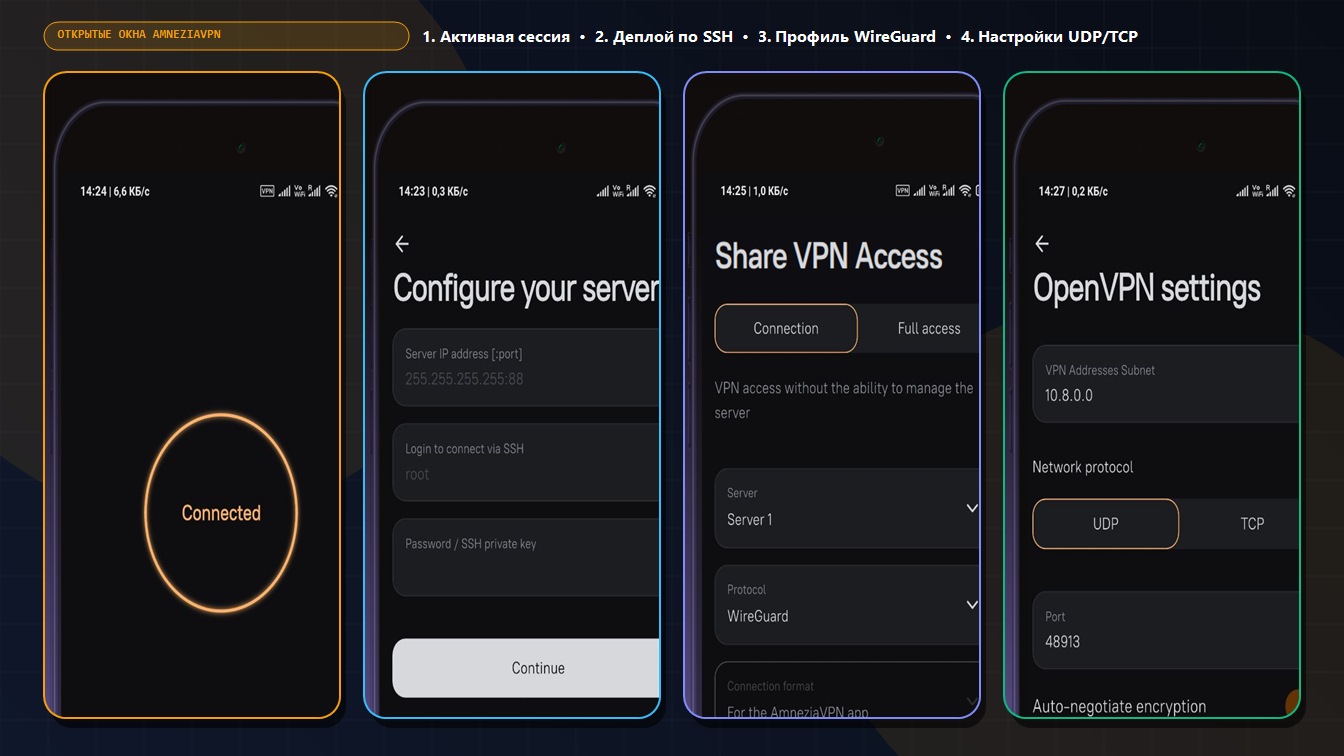
H1–H4), Custom Protocol Signature (CPS) decoy packets (I1–I5emulating QUIC, STUN, or DNS frames), and inter-packet timing jitter. - Amnezia 5.0.1.5 Enterprise Architecture: Built around self-hosted SSH container orchestration on dedicated corporate servers with zero third-party cloud relays or metadata leakage.
- SOC / Blue Team Perspective: Modern enterprise NGFWs are shifting from simple 4-byte offset rules to Shannon entropy and Inter-Arrival Time (IAT) flow telemetry.
1. Why Standard WireGuard Is Instantly Classified by Traffic Analyzers
Designed by Jason Donenfeld around the Noise_IKpsk2 framework, WireGuard was engineered as a streamlined replacement for complex IPSec and OpenVPN deployments. It intentionally omits cipher-suite negotiation: every peer uses Curve25519, ChaCha20-Poly1305, BLAKE2s, and SipHash24.
That determinism makes standard WireGuard trivial to identify on L4/L7 network sensors (Wireshark, Suricata, Zeek, and hardware NGFWs):
- Static First 4 Bytes: Every packet starts with a 1-byte type identifier (
0x01Initiation,0x02Response,0x03Cookie Reply,0x04Transport Data) followed by three reserved zero bytes (0x00 0x00 0x00). - Fixed Handshake Geometry: Handshake Initiation is always exactly 148 bytes of UDP payload, Handshake Response is exactly 92 bytes, and Cookie Reply is 64 bytes.
# Sample BPF/Wireshark filter detecting standard WireGuard Handshakes:
udp and (
  (udp.length == 156 and udp[8:4] == 0x01000000) or
  (udp.length == 100 and udp[8:4] == 0x02000000)
)
2. AmneziaWG 3.1 Protocol Architecture: Dynamic Headers & Statistical Mimicry
AmneziaWG modifies the WireGuard transport layer while preserving its underlying Noise_IK cryptography. In AmneziaWG 3.1 (shipped with the Amnezia 5.0.1.5 ecosystem), obfuscation operates across four distinct layers:
- Dynamic Magic Header Ranges (
H1–H4): Administrators define non-overlapping numeric intervals (e.g.,H1 = 214050100-214050900). Each transmitted packet picks a random 32-bit integer within its assigned range. - Randomized Padding Prefixes (
S1–S4): Prepends random-length padding before the handshake and transport structures, shifting cryptographic field offsets and altering packet lengths. - Pre-Handshake Junk Trains (
Jc,Jmin,Jmax): InjectsJcnoise packets bounded betweenJminandJmaxbytes prior to session initiation. - Custom Protocol Signatures (
I1–I5CPS): Structured byte templates (<b 0x...>static bytes,<r N>random bytes,<t>timestamp,<c>counter) that mimic legitimate UDP protocols such as QUIC Initial (RFC 9000) or STUN (RFC 5389).
3. Comparison Table: Standard WireGuard vs. AmneziaWG 3.1 & Enterprise Transports
| Architecture Metric | Standard WireGuard | OpenVPN 2.6 DCO | AmneziaWG 1.5 | AmneziaWG 3.1 (Client 5.0.1.5) |
|---|---|---|---|---|
| Transport Layer | UDP (Static Format) | UDP / TCP | UDP (Modified) | UDP + CPS Protocol Mimicry |
| Header Identifier | Static 0x01..0x04 |
Opcode + Session ID | Static custom H1–H4 |
Dynamic ranges H1–H4 + S1–S4 |
| Handshake Init Size | Strictly 148 bytes | Variable (TLS) | 148 + S1 bytes |
Dynamic + I1–I5 CPS preamble |
| Passive DPI Resilience | Low (1-packet detection) | Low (TLS/Opcode signature) | Moderate | High (QUIC/STUN structural mimicry) |
ChaCha20-Poly1305 cryptographic integrity.
Frequently Asked Questions (FAQ)
Does AmneziaWG 3.1 degrade throughput compared to standard WireGuard?
During active data transfer, throughput overhead is negligible (under 2–4%) because junk packets (Jc) and CPS signatures (I1–I5) are only transmitted during session handshake and rekeying.
How do enterprise NGFWs inspect modified UDP tunnels?
Advanced NGFWs validate full protocol state machines—verifying whether an initial QUIC header is followed by a specification-compliant RFC 9001 encrypted handshake—and analyze inter-arrival timing and payload entropy.
- AmneziaWG 3.1 Protocol & Amnezia 5.0.1.5 Architecture Research: WireGuard Header Randomization and Enterprise Tunnel Protection Against DPI Fingerprinting (Current Article)
- CSQTT Architecture Research (Rust / TURN / RTP): Multi-Stream Traffic Encapsulation in WebRTC Media Relays and Network Dispatcher Analysis
- VLESS Protocol & XTLS Reality Architecture: Cryptographic Analysis of TLS 1.3 Handshake, Active Probing Defense, and Zero-Overhead Vision Flow
- Comparative Analysis of Modern Network Transport Protocols (2026): Hysteria 2 (QUIC), TUIC v5, ShadowTLS v3, WireGuard, and OpenVPN DCO in Enterprise Networks
- DPI Traffic Analysis Technologies & TCP/TLS Packet Fragmentation Optimization: Architectural Breakdown of Zapret (nfqws) and ByeDPI from a Network Engineering Perspective


The shift from fixed byte offsets to Shannon entropy analysis is fascinating. How does AmneziaWG’s timing jitter affect latency-sensitive corporate traffic like VoIP? I’d love to hear how other network admins balance packet padding overhead against throughput on high-bandwidth links.