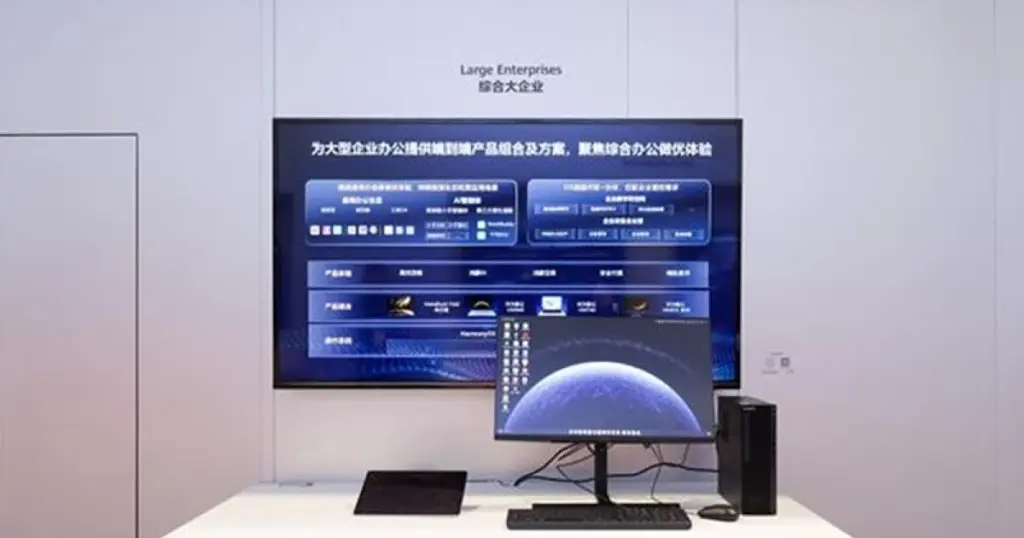
- Huawei has launched its first desktop PC, the Qingyun HM650, targeting enterprise and government clients, which the company claims is built entirely from Chinese-made components.
- The machine features Huawei’s own ten-core Kirin X90 processor clocked at 2.3 GHz and runs on the HarmonyOS Enterprise Edition.
- This development underscores China’s drive for technological self-reliance and poses a significant challenge to Western vendors like Intel and AMD in the vast government procurement market.
Huawei Introduces Qingyun HM650: A Desktop PC with 100% Chinese Components
Huawei has unveiled its inaugural desktop computer, the Qingyun HM650, designed for corporate and government customers. The company asserts that this is the industry’s first desktop PC to receive certification confirming the exclusive use of Chinese components, spanning from the processor to the power supply unit and operating system. This marks a substantial stride in China’s technological sovereignty strategy.
Technical Specifications and Domestic Components
At the core of the Qingyun HM650 is Huawei’s proprietary ten-core Kirin X90 processor, operating at a clock speed of 2.3 GHz. This chip incorporates ten Armv8-based Taishan CPU cores in a 4+4+2 configuration, with all cores supporting Simultaneous Multithreading (SMT) to execute up to 20 threads concurrently. The processor also integrates Huawei’s Maleoon graphics processing unit (Arm Mali-based) and a dedicated Neural Processing Unit (NPU) for AI workloads. According to a teardown analysis by TechInsights, the Kirin X90 is manufactured by SMIC using its 7nm-class N+2 process technology.
The PC comes equipped with 16 GB of LPDDR5 memory and either a 256GB or 512GB SSD. It features a dual-sided cooling system and an advertised power consumption of 40W. Huawei claims that all critical components, including memory, storage, power supply, and wireless connectivity, are domestically manufactured.
| Component | Specifications | Manufacturing (Claimed) |
|---|---|---|
| Processor | Kirin X90, 10 Cores (Taishan Armv8), 2.3 GHz, 20 Threads | Huawei (design), SMIC 7nm (fabrication) |
| Graphics | Huawei Maleoon GPU (Arm Mali-based) | China |
| AI Accelerator | Dedicated NPU | China |
| RAM | 16 GB LPDDR5 | China (likely CXMT) |
| Storage | 256 GB or 512 GB SSD | China (likely YMTC) |
| OS | HarmonyOS Enterprise Edition | Huawei (development) |
| Power Consumption | 40W | - |
HarmonyOS Enterprise Edition Operating System
The Qingyun HM650 runs on HarmonyOS Enterprise Edition, an operating system developed by Huawei to reduce reliance on foreign technology. Unlike earlier HarmonyOS versions that incorporated Linux components, this enterprise edition utilizes Huawei’s own kernel and software architecture. This grants the company greater control over development, security updates, and hardware integration, though compatibility with existing Windows applications might pose a limitation for some enterprise customers.
Implications for the Market and Technological Sovereignty
The debut of the Qingyun HM650 is a significant event, particularly in light of Beijing’s directive mandating all government entities to transition from Wintel boxes to local alternatives. Reports indicate that a single Chinese government agency has already ordered 600 of these machines. This represents a considerable challenge to the market positions of Intel, AMD, and Qualcomm in the massive Chinese government procurement sector, especially as the broader PC market shrinks due to rising memory costs.
While Huawei claims 100% Chinese-manufactured components, it remains uncertain if all these components use Chinese designs, given the presence of non-Chinese companies with manufacturing facilities in China. Nevertheless, this demonstrates Huawei’s capability to develop PC-class processors using domestically available semiconductor manufacturing capabilities, albeit on a process technology that trails leading-edge nodes from Intel, TSMC, and Samsung. For context, Germany Secures Nvidia AI Partnership and Amazon’s €16 Billion Investment, highlighting the global race for technological leadership.
For Chinese government and enterprise customers, the Qingyun HM650 offers a fully domestic alternative to traditional PCs, enhancing national security and supply chain resilience. For the global market, it signifies increased competition and a potential shift in the PC supply landscape, particularly in the context of a push for technological sovereignty. Limited compatibility with Windows applications might be a consideration for some businesses, but for those prioritizing independence from Western technologies, this PC represents a noteworthy advancement.



While the Qingyun HM650 represents an impressive step towards technological self-reliance, I wonder about the true performance implications. A 7nm process is notable, but how will the Kirin X90 truly stack up against established enterprise-grade processors from Intel or AMD in real-world, demanding scenarios? And while HarmonyOS offers sovereignty, the hurdle of application compatibility for businesses heavily invested in Windows ecosystems could be a substantial and costly barrier to widespread adoption, despite the patriotic appeal.