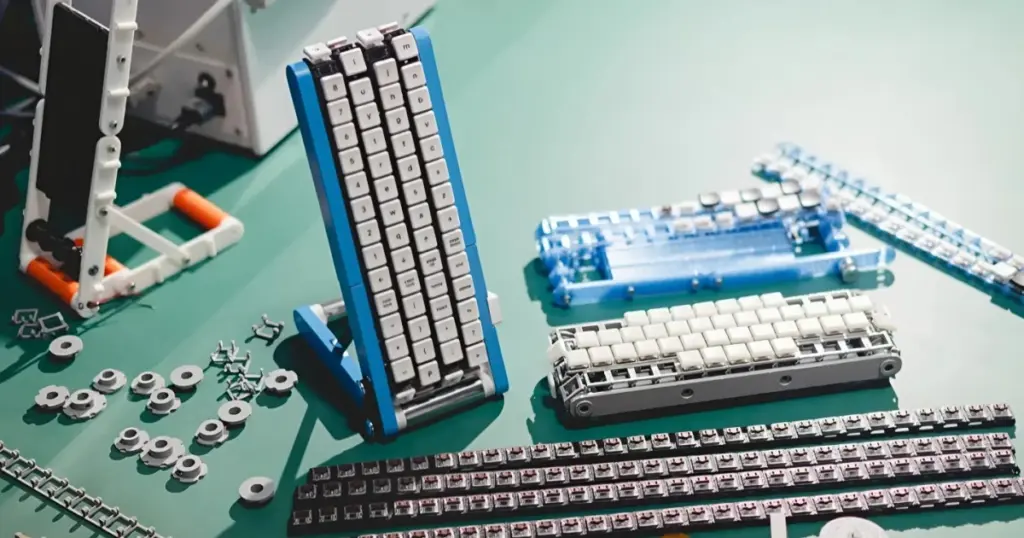
- The Japanese division of Google has, in its customary fashion, unveiled its fifteenth innovative keyboard project aimed at simplifying text input.
- The core idea behind the Gboard Kuru-Kuru is to minimize physical hand movement during typing.
- Although the Gboard Kuru-Kuru project serves primarily as a concept demonstration, it highlights Google’s ongoing exploration into enhancing user experience and interaction with technology.
Google Japan’s Latest Innovation: The Gboard Kuru-Kuru Vertical Conveyor Keyboard
The Japanese division of Google has, in its customary fashion, unveiled its fifteenth innovative keyboard project aimed at simplifying text input. Introduced on October 1st, the new development, named Gboard Kuru-Kuru, operates on a conveyor belt principle. This design eliminates the need for users to move their hands across the entire keyboard layout, instead delivering keys directly to the user’s fingers.
Understanding the Gboard Kuru-Kuru Concept
The core idea behind the Gboard Kuru-Kuru is to minimize physical hand movement during typing. Unlike traditional horizontal key arrangements, this vertical conveyor keyboard brings the necessary characters directly to the user’s fingertips. While the project, like many previous Google Japan initiatives, is presented with a playful or experimental character, it showcases an unconventional approach to familiar input devices.
- Vertical Layout: Keys move along a conveyor belt system.
- Reduced Hand Movement: Aims to lessen the need for extensive hand travel.
- DIY Project: Google has made the project open-source, allowing anyone to build it.
- Launch Date: Traditionally announced on October 1st.
Although the Gboard Kuru-Kuru project serves primarily as a concept demonstration, it highlights Google’s ongoing exploration into enhancing user experience and interaction with technology. Images for the project were sourced from Google’s official blog.



While the Gboard Kuru-Kuru’s concept of reduced hand movement is intriguing, I can’t help but wonder about the practicalities. A conveyor belt system sounds like it could introduce significant mechanical complexity and potential points of failure, not to mention the likely increase in manufacturing costs compared to standard keyboards. I’m also skeptical about the learnability curve and overall typing speed for complex tasks; constantly waiting for keys to cycle could prove counterproductive for touch typists.