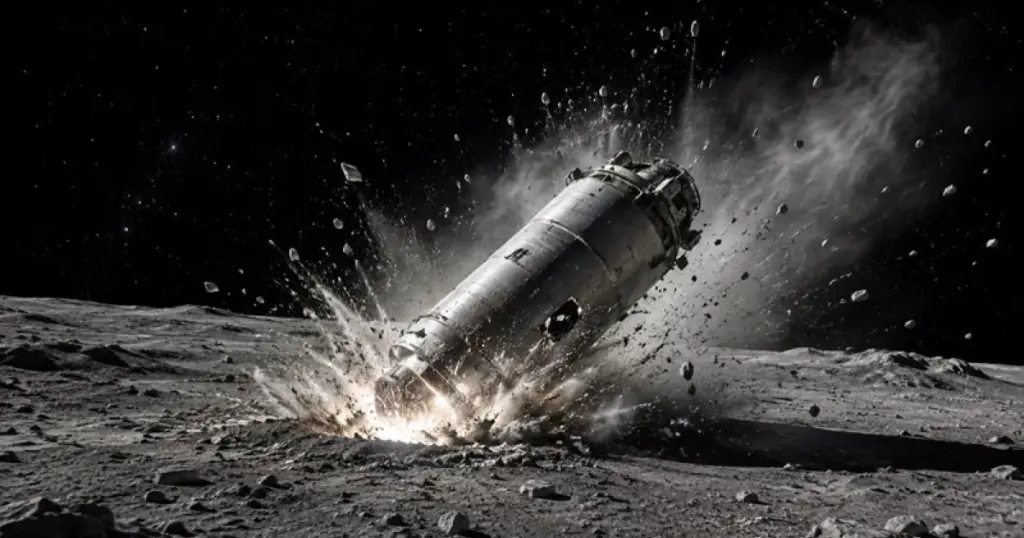
- The international astronomical community has received definitive confirmation of the spent upper stage of a Falcon 9 rocket colliding with the lunar surface.
- South Korea’s orbital probe, Danuri, was the first to capture visual evidence of the collision.
- Notably, China’s Gande-1 01 satellite also actively tracked the trajectory of the spent Falcon 9 second stage leading up to its lunar impact.
Falcon 9 Stage Impact on Moon Confirmed
The international astronomical community has received definitive confirmation of the spent upper stage of a Falcon 9 rocket colliding with the lunar surface. The incident occurred on the morning of August 5, 2026, when the four-ton stage impacted the Moon at approximately 2.4 km/s. Initial data, including spectral readings from the suspected impact zone, had already indicated this event, but direct evidence has now emerged.
Danuri Captures Crater Images
South Korea’s orbital probe, Danuri, was the first to capture visual evidence of the collision. It successfully photographed the new crater formed by the impact. The Falcon 9 stage, estimated to weigh between 3.9 and 4 tons, struck the Moon at approximately 09:34 Moscow time in the vicinity of the Einstein and Bell craters, near the lunar limb. Danuri began scanning this area half an hour before the calculated impact time and subsequently performed eight imaging sessions over the zone, enabling detailed images to be obtained.
China’s Gande-1 01 Tracked the Impact
Notably, China’s Gande-1 01 satellite also actively tracked the trajectory of the spent Falcon 9 second stage leading up to its lunar impact. This stage remained in an elongated Earth orbit after the launch of the Blue Ghost and Resilience lunar landers on January 15, 2025. For Chinese scientists, this event served as a valuable experiment to verify and refine models of celestial body impacts on Earth’s natural satellite, underscoring the global interest in this unique occurrence.



It’s fascinating how Danuri was able to pinpoint and image the Falcon 9 impact crater! I’m curious if the spectral readings mentioned earlier will reveal anything unique about the subsurface material exposed by the collision, compared to natural impacts. Also, given the Gande-1 01’s tracking, what specific refinements are Chinese scientists hoping to make to their celestial body impact models? I’d love to hear others’ thoughts on the scientific value of this unexpected lunar experiment.