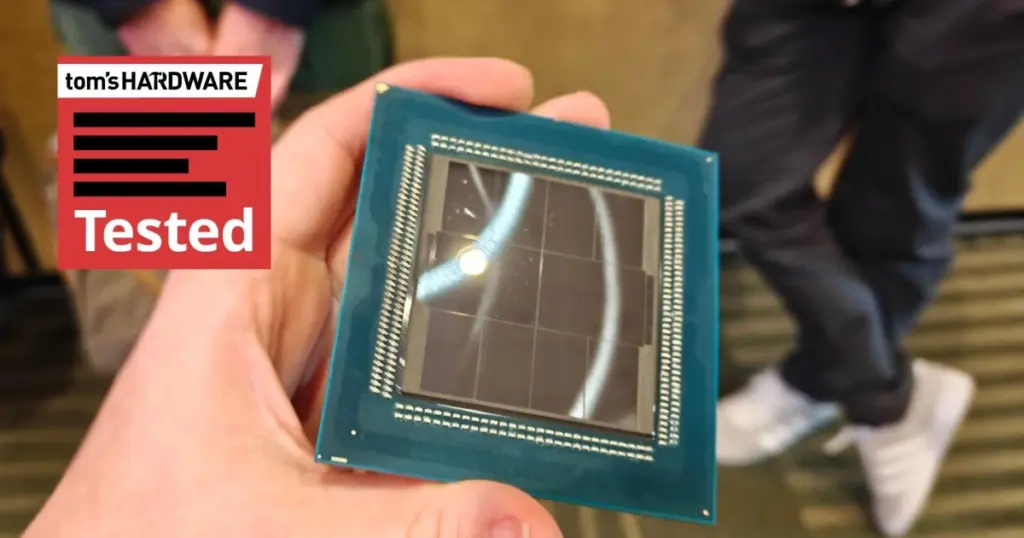
- AMD has unveiled its Zen 6 architecture with the EPYC ‘Venice’ CPUs, delivering significant performance and core density improvements.
- Zen 6 achieves an average 27% IPC uplift in enterprise, cloud, and AI workloads, along with increased core density up to 12 cores per CCD (Zen 6) and 32 cores (Zen 6c).
- These advancements lay the groundwork for next-generation consumer Ryzen processors, potentially enabling 24-core configurations.
AMD Unveils Zen 6 Architecture with EPYC ‘Venice’ Processors
AMD has officially disclosed details of its new Zen 6 architecture, making its debut in the EPYC ‘Venice’ server processors. These chips, including the 256-core EPYC 9996, demonstrate substantial performance improvements over previous generations and are designed to compete with Nvidia’s Vera and Intel’s Granite Rapids-AP solutions.
Core Architectural Innovations of Zen 6
Zen 6, built on TSMC’s N2P node, represents an evolution of Zen 5, which was a ground-up redesign of AMD’s core. Zen 6 expands upon this foundation, offering significant enhancements:
- Process Node: TSMC N2P, delivering an 18% speed improvement at iso-power or a 36% power reduction at the same speed compared to N3E.
- Vector Engine: A redesigned vector engine with native support for half-precision FP16 instructions and improved FP load bandwidth (two 512-bit or four 256-bit loads).
- Integer Schedulers: Split integer schedulers within the execution engine allow for more instructions in flight through the core.
- IODs: The introduction of two IODs (Input/Output Dies) for the first time, granting the SP7 platform access to 16 memory channels.
- Cache Enhancements: Increased op cache size to 6.75K entries and general-purpose registers to a 352-entry physical register file.
| Characteristic | Zen 5 | Zen 6 |
|---|---|---|
| Process Node | N4P | N2P |
| Cores per CCD | Up to 8 | Up to 12 |
| Cores per CCD (Zen 6c) | Up to 16 | Up to 32 |
| L3 Cache per Core | 4 MB | 4 MB |
| L3 Cache per CCD (Standard) | 32 MB | 48 MB |
| L3 Cache per CCD (Zen 6c) | 32 MB | 128 MB |
| Max Frequency (Standard CCD) | 5 GHz | 5.3 GHz |
| Max Frequency (Zen 6c CCD) | 3.7 GHz | 4.1 GHz |
| IPC Uplift (vs. Zen 5) | Base | +27% (enterprise, cloud, AI) |
| Op Cache Size | 6K entries | 6.75K entries |
| Physical Register File | 240 entries | 352 entries |
| FP16 Support | Via conversion | Native |
| Memory Channels (SP7) | 8 | 16 |
Performance and Competitive Landscape
AMD claims an average 27% IPC uplift for Zen 6 over Zen 5 in enterprise, cloud, and AI workloads, derived from comparing fixed-frequency Zen 5 to a 16-core Zen 6c. In SPEC CPU 2026’s intrate throughput test, the 256-core EPYC 9996 achieved a 93% lead over a 2P EPYC 9965 server.
AMD positions EPYC ‘Venice’ as a generation ahead of the competition. While Intel’s Diamond Rapids is slated for next year, AMD has set a high performance bar, which it intends to raise further with upcoming Venice-X and Verano platforms.
Dual Core Types: Zen 6 and Zen 6c
Similar to previous generations, Zen 6 comes in two variants: the frequency-optimized Zen 6 and the density-optimized Zen 6c. Both cores share the same microarchitecture and Instruction Set Architecture (ISA), distinguishing AMD’s approach from Intel’s P-core and E-core design. The primary differences between Zen 6 and Zen 6c lie in clock speeds and core density:
- Zen 6: Up to 12 cores per CCD, 48 MB shared L3 cache, maximum frequency up to 5.3 GHz.
- Zen 6c: Up to 32 cores per CCD, 128 MB shared L3 cache (quadruple that of Zen 5c), maximum frequency up to 4.1 GHz. L3 cache per core is doubled to 4 MB compared to Zen 5c.
This design allows AMD to offer up to 256 cores in a Zen 6c configuration for the SP7 platform.
Future Prospects for Consumer Ryzen Processors
Although the Zen 6 architecture debuts in the server segment, these innovations will form the foundation for the next generation of consumer Ryzen processors, codenamed Olympic Ridge, expected next year. The increased core density, allowing up to 12 cores per CCD, opens the possibility for 24-core Ryzen processors using two CCDs, which could lead to substantial performance gains in the client market.
For enterprise clients and data centers, AMD’s EPYC ‘Venice’ processors based on Zen 6 offer significant performance and power efficiency gains, critical for cloud computing, AI, and HPC workloads. For general users anticipating future Ryzen processors, the Zen 6 architecture promises substantial improvements in multi-core performance and overall efficiency, making the next generation of desktop PCs and laptops considerably more powerful.



I’ve been running Zen 4c EPYC ‘Bergamo’ in a few of our dev servers and the density has been a game-changer for specific containerized workloads. The IPC uplift for Zen 6 with ‘Venice’ sounds promising, especially if they can really hit that 27% in real-world AI inference tasks. My main concern is always memory bandwidth with high core counts, and the 16 memory channels on SP7 is a huge relief. However, getting those clocks to stay high under sustained load on the ‘c’ variants has been tricky; often requires careful power tuning. A good tip is to experiment with PBO limits, not just TDP.