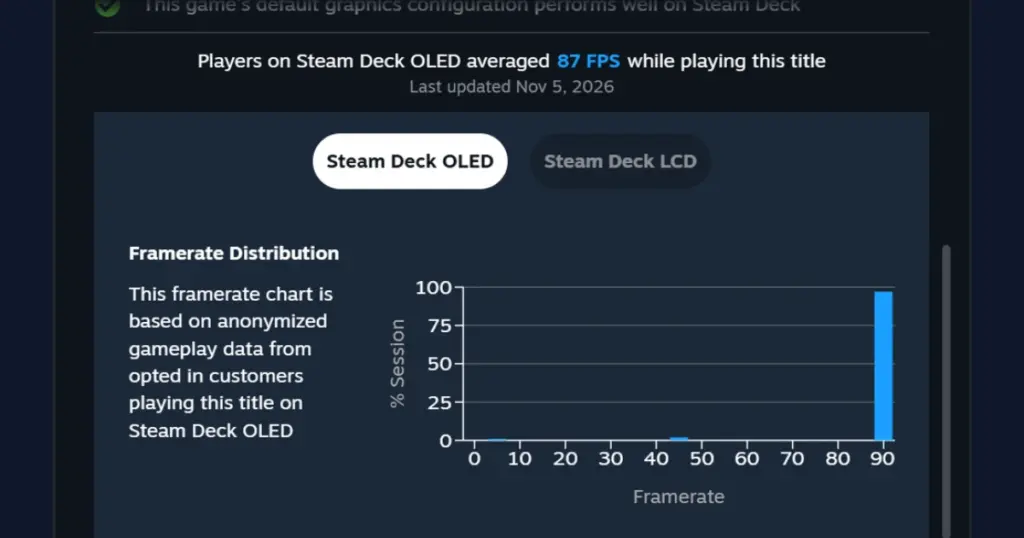
- Valve has launched a new feature displaying average framerate data for games on Steam Deck directly on Steam store pages.
- This data is sourced from anonymous telemetry provided by opted-in users and covers thousands of games tested for Steam Deck compatibility.
- The initiative aims to help players assess real-world game performance before purchase, with plans to extend support to other hardware platforms in the future.
Valve Boosts Steam Deck Performance Transparency
Valve has rolled out an update that integrates average frames per second (FPS) data directly into Steam store pages for games compatible with the Steam Deck. This feature is designed to empower users with clearer insights into how games perform on the handheld device, aiding in more informed purchasing decisions.
How the New Feature Works
The new system displays average FPS values, calculated from anonymized data voluntarily shared by Steam Deck users. Valve emphasizes that privacy is maintained, and the data is aggregated across thousands of games that have undergone Steam Deck compatibility testing, including those marked as ‘Verified’, ‘Playable’, and even ‘Unsupported’.
To access this information, users can navigate to a game’s store page, locate the ‘Steam Deck Compatibility’ section on the right-hand side, and click ‘Learn more’. Beyond the average FPS, a framerate histogram is also available, illustrating the distribution of data points across various FPS values, offering a deeper understanding of performance stability.
Accuracy and Future Expansion
Valve acknowledges that factors such as enabled VSync or framerate limits, as well as custom in-game settings, can influence the collected data. However, the company states that despite these variables, the framerate data ‘consolidates around relatively narrow ranges.’
Currently, the data is filtered to show information only from Steam Decks set to default frame limits. Valve views this update as ‘a stepping stone toward providing framerate data for more devices than just Steam Deck,’ with intentions to expand this functionality to other hardware platforms, including desktop gaming PCs and future Valve devices. This continuous enhancement of the Steam platform further solidifies its position as a leading digital game storefront, offering unique value to its user base.
For Steam Deck owners, this feature represents a significant improvement, enabling them to anticipate a game’s performance before purchase, thereby reducing the risk of acquiring titles that might not run to their satisfaction. This is particularly valuable given that a ‘Verified’ status doesn’t always align with individual playability expectations. For Valve, it’s a strategic move to enhance transparency and user satisfaction, while also gathering valuable data for future platform optimization and development.



This integration of real-world framerate telemetry for Steam Deck is a significant step towards enhancing pre-purchase transparency. While the aggregation of anonymous user data provides a valuable baseline, it’s critical to consider the variance introduced by user-configured TDP limits and shader cache states, which can significantly impact reported FPS. Expanding this to desktop platforms will necessitate more granular filtering, potentially by GPU model and CPU generation, to maintain data relevance and accuracy for a diverse hardware ecosystem.