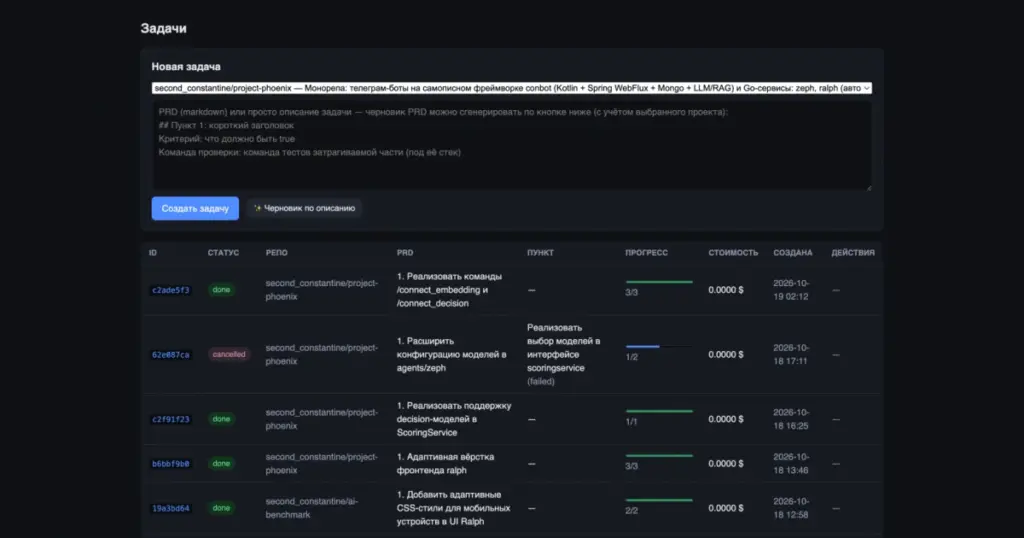
- AI agents are being actively integrated into software development, automating code writing, documentation, and task management.
- Shifting from chat-oriented AI to agents operating within the entire CI/CD pipeline significantly boosts efficiency, saving up to 68 cents per task.
- Despite individual developer productivity increasing 2-3 times, AI implementation necessitates workflow reorganization to maintain or accelerate team pace.
AI Agents Reshape the Development Landscape
Artificial intelligence continues to permeate all facets of software development, from writing code in integrated environments to automating cloud processes. This trend is prompting many professionals to explore the inner workings and capabilities of AI agents, seeking to understand their potential and limitations. Developers are actively building their own agents for personal projects, aiming to master new methodologies and determine what works and what doesn’t in real-world scenarios.
Process Automation: From Chat to CI/CD
Traditional AI use in development often confines itself to chat interfaces, where developers manually relay tasks, approve solutions, and update statuses. However, this approach does not always lead to significant team acceleration, as time saved on code writing can be consumed by coordination and routine operations. Experts propose a new approach where AI agents are integrated directly into CI/CD workflows, automating every development stage: from analysis and architecture to planning and code generation.
In such a system, a task from a tracker automatically progresses through stages executed by agents, with analysts, architects, and developers intervening only for key decisions. This significantly reduces overheads and enhances overall efficiency.
| Parameter | Traditional AI Chat Approach | Process-Oriented AI Agent Approach |
|---|---|---|
| AI Interaction | Manual task relay, constant approval | Automated task flow through stages |
| Developer Role | Information carrier, manual status updates | Focus on critical decisions and oversight |
| AI Operating Environment | Chat, local tools | Integrated into CI/CD pipeline |
| Cost Savings per Task | Minor or none | Up to 68 cents per task (1C example) |
Challenges and Prospects of AI Agent Implementation
Despite clear advantages, implementing AI agents comes with specific challenges. Anton Kalutsky, head of DEVCOM, notes that while AI can accelerate an individual employee by 2-3 times, the overall team speed may remain unchanged or even slow down. This occurs because time saved at one stage might translate into additional work at the next, requiring thorough verification and refinement of AI-generated outputs. For instance, major US banks are already restricting AI agent access to customer accounts due to concerns about unauthorized actions.
Effective AI agent operation necessitates a profound restructuring of processes. An example is the organization of business module development on ELMA 365, where agents modify forms and scripts, conduct checks, and generate documentation. Initially, issues arose from multiple agents working simultaneously in the same project folder, leading to conflicts and errors. The solution involved creating a structured environment where agents operate in isolation, and their commits do not interfere with others’ tasks, ensuring utility without disruption.
For companies and developers, this signifies the need to rethink current workflows. Simply using AI chats to accelerate individual tasks is insufficient. The true value of AI agents is unlocked through their deep integration into end-to-end development processes, where they can autonomously execute project lifecycle stages. This requires investment in designing new interaction architectures between agents and humans, as well as training teams to work with new tools to achieve a synergistic effect and truly boost the productivity of the entire team, not just individual members.



The shift from chat-centric AI to agents embedded within the CI/CD pipeline represents a critical evolution, addressing the inherent limitations of fragmented AI assistance. While the article highlights a potential 68-cent saving per task, the deeper impact lies in reducing cognitive load and ensuring consistent adherence to architectural patterns, which can significantly mitigate technical debt. The challenge of maintaining team velocity despite individual gains underscores the need for robust validation frameworks and clear human-in-the-loop protocols, particularly in highly regulated environments where autonomous agent actions could pose substantial compliance risks.