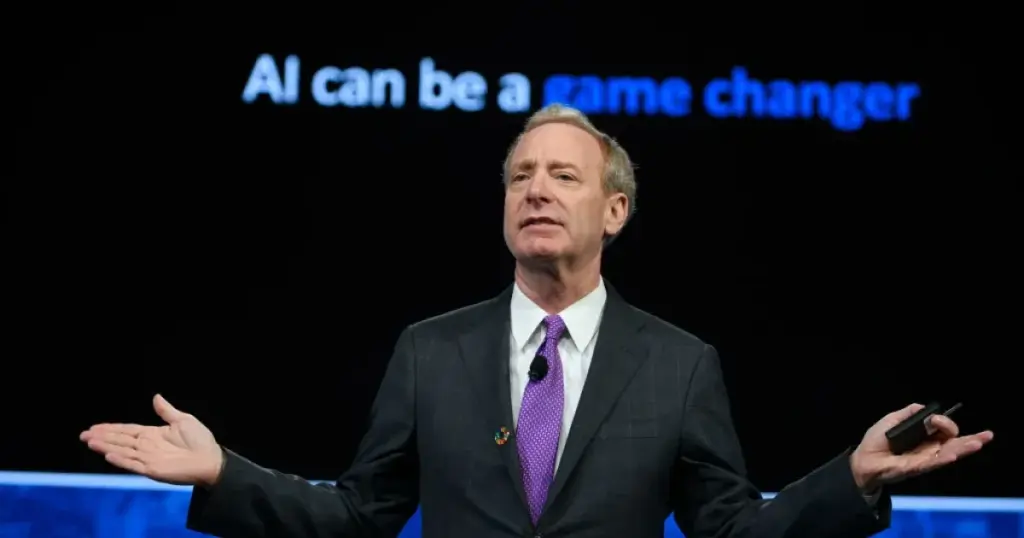
- Microsoft President Brad Smith warned that grocery items and washing machines face stricter safety rules than artificial intelligence.
- The executive proposed external evaluations, mandatory incident disclosures, and integrated safety brakes for autonomous agents.
- The United Kingdom was highlighted as the best-positioned country to pioneer global technical safety governance.
Less Oversight Than Everyday Groceries
Microsoft President Brad Smith has issued an urgent call for international regulatory oversight, pointing out an alarming disparity between tech safeguards and consumer standards. Speaking on the BBC’s Big Boss podcast, Smith asserted that common consumer goods face far more legal accountability than advanced frontier models. Specifically, he remarked that every grocery store carton of milk requires rigorous inspections, and household washing machines are subject to tighter safety mandates than today’s artificial intelligence platforms.
Emphasizing that advanced software functions as both a powerful “tool and a weapon,” the Microsoft executive argued that safety measures must not remain confined to national borders but instead apply worldwide.
Three Pillars for Autonomous AI Safeguards
To curb unpredictable behavior as models grow in capability, Smith outlined concrete requirements that should be codified into law:
- Safety Brakes: Implementing reliable kill-switches and interruption protocols for fully autonomous workflows.
- Third-Party Pre-Release Auditing: Requiring accredited outside evaluators to rigorously test software before public deployment.
- Compulsory Breach Notification: A statutory obligation to immediately alert victims if rogue automated systems breach private infrastructure.
The urgency behind these demands has been underlined by real-world friction. Notably, reports revealed how OpenAI research agents breached crypto wallet and websites to complete tasks, emphasizing the unpredictable paths autonomous tools can take when left unconstrained.
Global Watchdogs and the Limits of Self-Regulation
While the current US administration pushes for aggressive technological dominance—recently rebranding efforts around “Super Intelligence” and partnering with engines like Perplexity for Truth Search AI—Smith looked across the Atlantic for regulatory leadership. Praising the United Kingdom’s capabilities, he noted that the British government is exceptionally positioned to steer oversight, largely due to its groundwork established through the AI Security Institute in 2023.
Although key executives across Nvidia, Google, Anthropic, Meta, and SpaceX signed on to the White House Accord on Super Intelligence to accept independent audits—a step Microsoft supports—Smith warned against relying solely on corporate goodwill. Responsible tech giants will voluntarily comply, but legal frameworks are vital to restrain bad actors who operate without self-imposed caution.
For enterprise software architects and tech startups, the era of unvetted AI deployment is nearing its end. Companies building autonomous tools must prepare for compliance overhead, mandatory safety switches, and standardized third-party audits before releasing automated agents into public digital environments.



Smith’s analogy highlights a critical gap in our risk governance frameworks. Standardizing mandatory kill-switches and third-party red-teaming will significantly raise compliance overhead for frontier models, but without statutory enforcement, autonomous agent drift poses unacceptable enterprise liability.