- The KDE project celebrates its 30th anniversary with the release of KDE Plasma 6.8 “30th Anniversary Edition.”
- Native X11 desktop sessions are officially deprecated and removed; the environment now runs exclusively on Wayland, with XWayland handling legacy software.
- Major enhancements include default Nvidia triple buffering, ICC/HLG HDR support, remote desktop (KRdp) upgrades, and the kscreenctl CLI utility.
Marking exactly 30 years since founder Matthias Ettrich posted the original KDE announcement on October 14, 1996, the KDE community has officially released KDE Plasma 6.8. Dubbed the “30th Anniversary Edition,” this milestone update sets the course for modern desktop Linux by retiring native X11 session support and fully committing to the Wayland display architecture.
The Wayland Transition: Saying Farewell to X11
After more than four decades of X11 powering Unix desktops, Plasma has officially closed the door on launching standalone X11 sessions. KWin now serves as both window manager and Wayland compositor. While legacy X11 applications remain fully functional through the XWayland compatibility layer, launching an unmediated X11 desktop session is no longer supported directly within Plasma 6.8.
Telemetric data shared by the developers indicated that by June, over 95% of Plasma 6.6 users had already adopted Wayland, with overall adoption hovering around 76% across older builds. The architectural shift nevertheless introduces notable operational changes:
- Window Management: Window “shading” (rolling a window into its titlebar) is removed permanently without plans for reintroduction;
- Window Placement: Applications can no longer arbitrarily position their own windows on screen, leaving coordinates entirely to compositor logic;
- Screen Capture: Legacy X11 screen recorders will cease to function, shifting the focus to native Wayland portals;
- Alternative Branches: Users requiring legacy X11 KWin infrastructure can monitor community initiatives like the SonicDE project, which forks Plasma 6.7.
Core Architectural Upgrades in Plasma 6.8
Alongside its foundational display protocol shift, Plasma 6.8 introduces significant rendering and usability enhancements across graphics, multi-monitor setups, and system tools.
| Feature / Subsystem | Implementation in Plasma 6.8 |
|---|---|
| Nvidia Graphics | Triple-buffered rendering enabled by default for stutter-free animations |
| HDR Architecture | Color profile handling via ICC profiles and support for Hybrid Log Gamma (HLG) |
| Display Management | Color-coded display identification in settings and the new kscreenctl CLI utility |
| Remote Desktop | Upgraded KRdp server featuring adaptive bitrates, bi-directional clipboard, and virtual display locking |
| Screen Recording | Spectacle now captures simultaneous system audio and microphone inputs |
| Data Protection | Deep desktop integration of the Kup backup tool |
Graphics Polish, System Monitoring, and Desktop Features
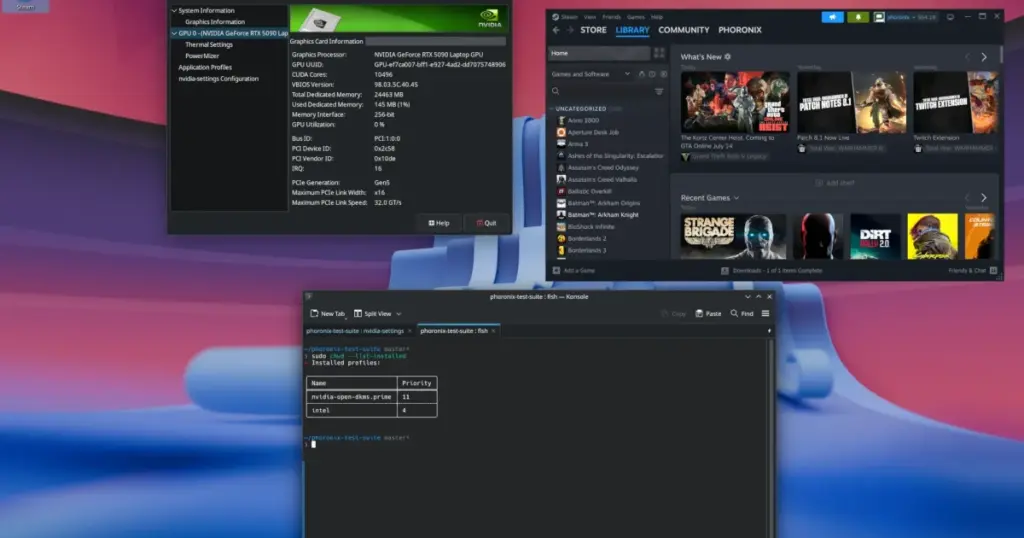
Hardware performance sees significant optimization. With Nvidia triple buffering turned on by default, Plasma delivers consistently smooth desktop effects. Global animation settings now reliably control behaviors like desktop “peek” and window “aperture” transitions. Furthermore, KWin can now apply shadows and rounded corners to client-side decorated windows, including Valve’s Steam client.
System monitoring tools have also received functional upgrades as the open-source platform continues to mature alongside foundational components—comparable to recent shifts such as when Linux kernel dropped mandatory AI tag requirements. Plasma’s System Monitor now reports VRAM consumption alongside traditional system RAM and allows administrators to pin specific tasks to designated CPU cores. The Union theming system is present in beta form, GTK2 dark-theme fidelity has been improved, and browser integration now supports the Flatpak release of Microsoft Edge.
Remote Workflows and Distribution Rollout
To offset the loss of X11-dependent remote tools, Plasma 6.8 revamps its KRdp Remote Desktop protocol implementation. KRdp dynamically adapts to low-bandwidth connections, synchronizes clipboards bidirectionally, and provides an exclusive mode that locks physical host monitors while generating a client-tailored virtual canvas. Krfb remains available for VNC users, while Waypipe handles remote application forwarding over SSH.
Kubuntu 27.04 (“Tenacious T-Rex”) is slated to deliver Plasma 6.8 to users upon its scheduled arrival in April.
Plasma 6.8 establishes Wayland as the mandatory foundation for modern KDE environments. Nvidia users benefit immediately from triple buffering and enhanced HDR handling. However, systems reliant on legacy X11 session-specific workflows or custom screen-capture pipelines must transition to Wayland-native interfaces or stay anchored to the Plasma 6.7 release branch.


Dropping native X11 completely feels like a massive historical milestone for the Linux desktop. How noticeable has the latency impact been with default Nvidia triple buffering enabled, especially when gaming? I’d also love to hear from anyone using HDR on Linux—is color management via ICC finally consistent across apps?