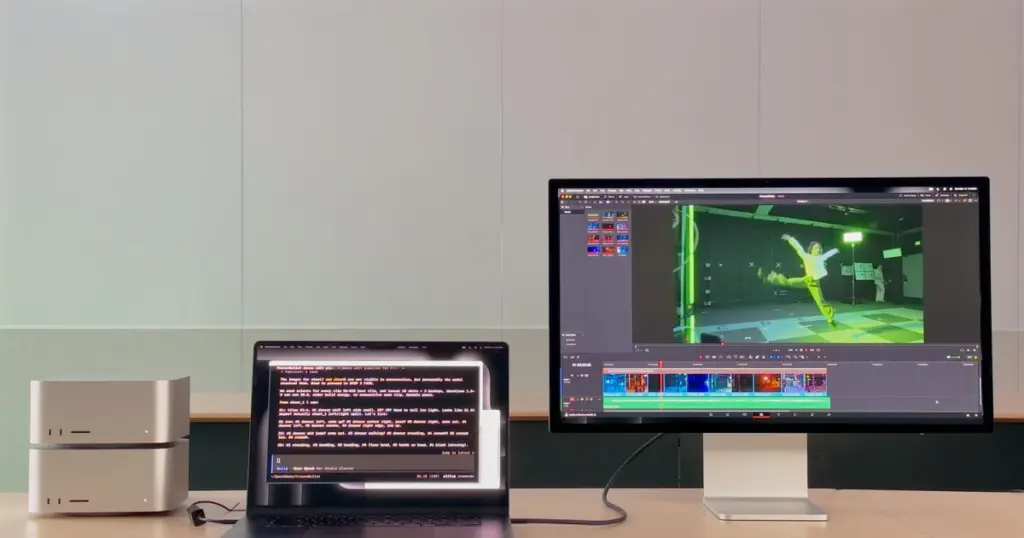
- Meta has released Muse Spark Open, an 816-billion-parameter model labeled the most capable open-weight AI built in the US.
- The massive architecture requires approximately 1TB of RAM to run locally on desktop hardware.
- Engineered with Apple using the MLX framework, it is optimized to run across two Mac Studio workstations powered by the M5 Ultra chip.
Meta’s Most Powerful Open-Weight Architecture
Meta has expanded its artificial intelligence ecosystem with the release of Muse Spark Open, making its model weights publicly accessible. The company describes the release as the “most capable US open-weight model to date.” Featuring an immense scale of 816 billion parameters, Muse Spark Open represents an ambitious step forward in providing advanced weights to the developer community.
According to initial benchmark evaluations, Muse Spark Open surpasses rival open-weight models from Nvidia and Thinking Machines in agentic workflows. However, in broader composite evaluations, the model still trails leading Chinese alternatives such as Kimi K3 and GLM 5.3.
The Apple Partnership: Desktop Scaling on M5 Ultra
A primary highlight of this release is the collaboration between Meta and Apple to deliver local execution on Apple silicon. Muse Spark Open has been tailored specifically to leverage Apple’s open-source MLX framework, allowing the massive architecture to run directly on consumer-class workstation hardware rather than enterprise server racks.
Running an 816-billion-parameter network locally comes with demanding hardware requirements. Users will need around 1TB of unified RAM to host and execute the model. Meta notes that Muse Spark Open is the first model in its tier designed to operate on a desktop setup powered by two interconnected Apple Mac Studio systems equipped with the M5 Ultra processor.
| Specification | Muse Spark Open Details |
|---|---|
| Developer | Meta |
| Parameter Count | 816 Billion Parameters |
| Memory Footprint | ~1TB Unified RAM |
| Target Hardware | Dual Apple Mac Studio (2× M5 Ultra) |
| Framework | Apple MLX |
| Benchmark Standing | Outperforms Nvidia and Thinking Machines in agents; trails Kimi K3 and GLM 5.3 overall |
As Apple silicon continues to evolve into a serious platform for machine learning inference, developers are seeing desktop hardware encroach on tasks previously reserved for cloud clusters, a trend also highlighted in our look at the Apple ecosystem expansion across enterprise and consumer hardware.
While the hardware barrier of 1TB RAM and dual M5 Ultra Mac Studios puts local execution out of reach for average users, it creates an entirely new tier of private, on-premise AI engineering for enterprises and research labs looking to avoid cloud subscription lock-in and data sharing.



Splitting an 816B parameter model across dual Mac Studios via MLX is wild. Does anyone know what kind of interconnect latency they are seeing between the two machines? I wonder if quantization could bring this footprint down to a single box soon.