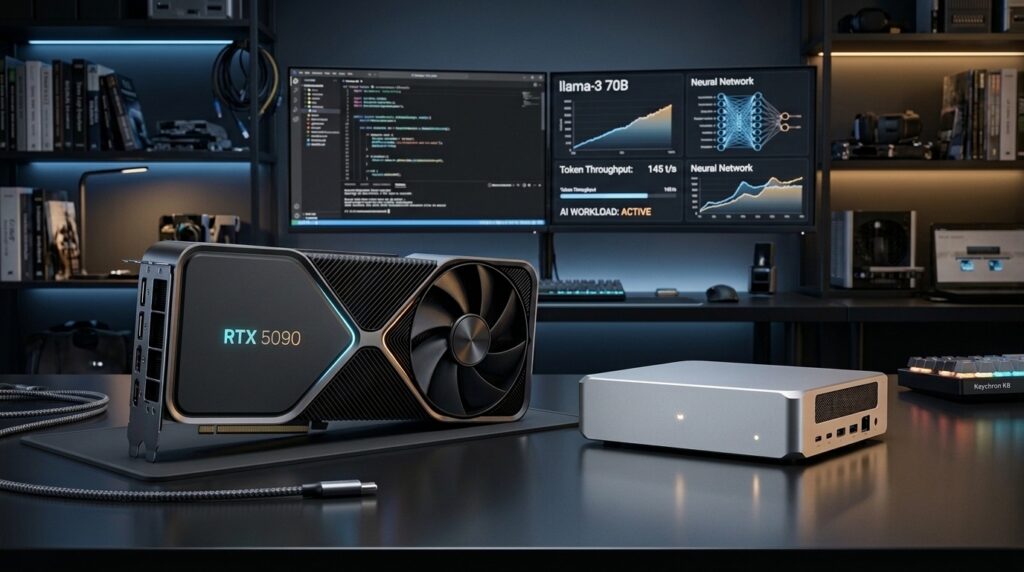
In 2026, the consumer and professional local AI industry reached a critical turning point: raw compute power (TFLOPS) is no longer the sole metric defining local hardware efficiency. The meteoric explosion of the enterprise AI datacenter market — centered around NVIDIA Blackwell B200 and GB200 NVL72 clusters — has triggered an unprecedented worldwide deficit in ultra-fast GDDR7 and HBM3e memory. Consequently, the traditional playbook of “just buying a flagship GeForce GPU” has slammed into a severe economic and architectural wall. Enter integrated AI stations powered by massive Unified Memory Architecture (UMA): from the open-platform AMD Strix Halo (Ryzen AI Max+ 395) and the flagship Apple Mac Studio M5 Max / M5 Ultra (up to 1,080 GB/s bandwidth) to purpose-built personal supercomputers like the NVIDIA DGX Spark / RTX Spark powered by the GB10 chip and the Microsoft Surface RTX Spark Dev Box paired with the NVIDIA PAIR runtime ecosystem. In this technical deep dive, we examine why discrete GPUs like the RTX 5090 fall short in deep text analytics and code reasoning, why they remain indispensable for video generation, and how the 2026 memory shortage reshaped the real cost of local AI.
- 2026 Memory Crisis Skyrocketed Discrete GPU Costs: Hyper-scaler prioritization for TSMC CoWoS packaging and wafer quotas has severely restricted GDDR7 supply. Real street prices for the NVIDIA GeForce RTX 5090 (32GB) hover around $2,499–$2,899, pushing complete system build costs past $4,400.
- NVIDIA DGX Spark & the GB10 Monolithic Superchip: NVIDIA’s direct answer to the UMA dilemma. The GB10 combines a 20-core Grace ARM CPU (Neoverse V3) with a Blackwell GPU across a coherent NVLink-C2C bus (900 GB/s) and 128GB–256GB of unified LPDDR5X. Developers gain a massive contiguous VRAM buffer without sacrificing native CUDA, cuDNN, or TensorRT compatibility.
- Microsoft Surface RTX Spark Dev Box & NVIDIA PAIR Ecosystem: A purpose-built enterprise workstation co-engineered by Microsoft and NVIDIA ($3,499–$4,199) driven by the NVIDIA PAIR (Personal AI Research & Runtime) software layer. It enables one-click deployment of DeepSeek R1, Qwen 2.5, and autonomous agent swarms with FP4 micro-scaling and seamless DGX Cloud scale-out.
- The Apple Mac Studio M5 Generation Leap (M5 Max / M5 Ultra): Apple’s M5 silicon with UltraFusion-3 shatters previous limits, delivering 540 GB/s (M5 Max) and a record-breaking 1,080 GB/s (M5 Ultra) of memory throughput. High-tier 256GB–512GB UMA builds can run full unpruned 671B DeepSeek R1 / V3 MoE architectures completely in local memory.
- The Economics of VRAM Cost per Gigabyte: An AMD Strix Halo (128GB) mini-PC retails around $2,100 (~$21/GB). An RTX Spark / Surface Dev Box (128GB) costs ~$3,500 (~$27/GB with native CUDA). On the RTX 5090, VRAM cost exceeds $85/GB — three to four times higher!
- Workload Specialization: For generative video (Wan 2.1 / 2.2, Flux), discrete RTX 5090 cards and GB10 Spark systems dominate by 3x to 6x thanks to Blackwell FP4/FP8 tensor cores. For code, text analytics, and 70B+ LLMs, unified memory stations (Strix Halo, Mac Studio M5, DGX Spark) have decisively eclipsed traditional discrete PCs.
1. The 2026 Memory Crunch: Why GDDR7 and HBM Prices Surged
To understand the current pricing dynamics of local AI hardware, one must look at the semiconductor supply chain. Throughout 2025 and 2026, hyper-scalers (Microsoft, Google, Meta, xAI, Oracle) aggressively bought up foundry capacity at TSMC, booking over 65% of advanced wafer packaging lines (CoWoS-L and CoWoS-S) for enterprise NVIDIA Blackwell (B200, GB200 NVL72) chips and proprietary custom ASICs.
Each GB200 NVL72 rack requires hundreds of gigabytes of stacked HBM3e memory, commanding enormous profit margins for DRAM manufacturers (SK Hynix, Micron, Samsung). This created a structural shift: foundries reallocated production lines away from discrete consumer graphics memory standards like GDDR7.
Furthermore, deploying a discrete GPU workstation requires an uncompromising host ecosystem to support Blackwell’s 550W–600W thermal footprint:
- An ATX 3.1 / PCIe 5.1 power supply rated at 1200W+ with native 12V-2×6 connectors ($240+).
- A high-tier host CPU (AMD Ryzen 9 9950X or Intel Core Ultra 9 285K) to avoid tokenization and tensor preparation bottlenecks ($550–$650).
- A robust PCIe 5.0 motherboard with reinforced trace shielding ($350–$500).
- 64GB to 128GB of high-speed DDR5-6400+ host memory ($250–$480).
- A high-airflow chassis with a 420mm liquid cooling radiator ($350).
In total, an RTX 5090 workstation sets buyers back $4,400 to $5,100. Attempting a dual-GPU rig (2x RTX 5090 for 64GB VRAM) pushes budgets well over $8,000, while introducing severe physical hurdles: 1200W+ heat output, 50dB blower noise, and the requirement for a dedicated electrical circuit in the workspace.
By contrast, the LPDDR5X ecosystem avoided this price shock. Produced in massive volumes for smartphones and thin-and-light laptops, 256–512-bit wide LPDDR5X memory implementations provide low-cost access to massive capacities without boutique silicon fabrication premiums.
2. The Architectural Paradigm Shift: Why Memory Bandwidth Trumps TFLOPS
A critical mistake when evaluating AI hardware in 2026 is judging systems solely by synthetic FP16/FP8 TFLOPS or NPU TOPS ratings. Deep learning workloads fall into two fundamentally distinct computational regimes:
| Architectural Attribute | Image & Video Generation (Diffusion / DiT) | Language Models & Reasoning (LLM / Reasoning) |
|---|---|---|
| Workload Regime | Compute-Bound (Constrained by matrix execution units) | Memory-Bandwidth Bound (Constrained by memory bus throughput) |
| Mathematical Operation | Dense matrix-matrix multiplication (GEMM) | Autoregressive matrix-vector multiplication (GEMV) |
| VRAM Capacity Demands | Moderate: models sit between 8GB and 20GB (Flux, Wan 2.1) | Massive: 70B models require 40GB–80GB + 20GB–40GB KV Cache |
| System Bottleneck | Raw Tensor Core counts and CUDA clock speeds | Memory bus width and total addressable RAM pool |
The Physics of LLM Inference: The Bandwidth Formula
During autoregressive text generation, a large language model predicts one token at a time. To produce a single token, the execution core must sweep the entire parameter weight matrix out of memory. The theoretical generation speed in tokens per second closely adheres to this formula:
Inference Throughput (Tokens/sec) ≈ Memory Bandwidth (GB/s) ÷ Model Weight Size (GB)
Consider the leading open-weights model Qwen 2.5 72B or the reasoning model DeepSeek-R1-Distill-Qwen-70B. In standard Q4_K_M 4-bit quantization, the model file occupies 43.5GB. In unquantized or 8-bit precision (Q8_0), it requires roughly 76GB.
The NVIDIA GeForce RTX 5090 is hard-capped at 32GB of GDDR7. The RTX 5080 features only 16GB. Neither card can physically fit a 70B class model inside its onboard memory!
The PCIe Offload Bottleneck
What happens when an engineer tries to run a 70B model on an RTX 5090? Inference runtimes (llama.cpp, Ollama, vLLM) split layers between the GPU and host system: the first 30 layers fit into the 32GB GDDR7 pool, while the remaining 45 layers spill into host DDR5 RAM.
The KV Cache Context Window Explosion
In 2026, real-world developer workflows demand context windows ranging from 32,000 to 128,000 tokens to feed entire repositories, unit tests, and API documentations into local context.
For a 70B parameter model, a 64k token context window requires 18GB to 26GB of dedicated RAM just for the Key-Value (KV) Cache! Even a mid-sized 32B model (such as Qwen 2.5 Coder 32B, which occupies ~20GB in 4-bit) immediately triggers a CUDA Out of Memory (OOM) crash on a 32GB RTX 5090 once context passes 40,000 tokens.
3. The 2026 Landscape of Local AI Hardware & Turnkey Stations
The semiconductor industry’s answer to this VRAM ceiling was the commercialization of turnkey workstations utilizing high-bandwidth Unified Memory Architecture (UMA). In these designs, CPU, GPU, and NPU cores share a contiguous, ultra-wide memory fabric with zero bus-copy penalties.
| Platform / Device | Silicon Configuration | Memory Capacity (UMA / VRAM) | Bus Width & Bandwidth | Peak System TDP | Real Street Price 2026 |
|---|---|---|---|---|---|
| NVIDIA DGX Spark (Grace-Blackwell GB10) |
20 Grace ARM cores (Neoverse V3) Blackwell GPU (14,000+ CUDA) NVLink-C2C Coherent Fabric |
128GB – 256GB LPDDR5X (100% addressable by CUDA) |
512-bit / C2C 860 GB/s |
190W | $3,999 – $5,499 (Desktop Supercomputer) |
| Microsoft Surface RTX Spark Dev Box (GB10 Edition) |
20 Grace ARM cores + Copilot NPU Blackwell GPU + Hardware FP4 Windows AI & WSL-AI Stack |
128GB LPDDR5X (Up to 112GB for AI models) |
512-bit 720 GB/s |
175W | $3,499 – $4,199 (Surface Pro Dev Station) |
| Apple Mac Studio M5 Max | 18 CPU cores (14P + 4E) 44 GPU cores (Metal 4) Integrated AI Matrix Engines |
128GB – 192GB UMA (Up to 105–160GB for AI) |
512-bit LPDDR5X 540 GB/s |
120W | $3,999 – $4,499 (Complete Station) |
| Apple Mac Studio M5 Ultra | 36 CPU cores (28P + 8E) 88 GPU cores (UltraFusion-3) Dual Neural Engine |
192GB – 512GB UMA (Up to 165–440GB for AI) |
1024-bit Bus 1,080 GB/s |
195W | $6,299 – $7,499 (Complete Station) |
| AMD Strix Halo Mini-Station (Ryzen AI Max+ 395) |
16 Zen 5 cores (32 threads) Radeon 8060S iGPU (40 CU RDNA 3.5) XDNA 2 NPU (50+ TOPS) |
128GB LPDDR5X (Up to 96–112GB for AI) |
256-bit 273 GB/s |
120W | $1,899 – $2,299 (Complete Turnkey Mini-PC) |
| Custom PC Build: NVIDIA RTX 5090 (32GB) |
Ryzen 9 9950X / Core i9 RTX 5090 Blackwell (21,760 CUDA) 5th Gen Tensor Cores |
32GB GDDR7 (GPU) + 64GB DDR5 (Host) |
512-bit GDDR7 1,792 GB/s |
850W–950W (Full System) |
$4,400 – $5,100 (Full PC Rig) |
| Dual Discrete Rig: 2x RTX 5090 (64GB VRAM) |
Threadripper 7000 / Xeon W 2x RTX 5090 (PCIe 5.0 x8/x8) 128GB DDR5 ECC |
64GB GDDR7 (2x 32GB) + 128GB DDR5 |
2x 512-bit 2x 1,792 GB/s |
1,500W–1,700W | $8,200 – $9,600 (Heavy Workstation) |
NVIDIA DGX Spark & the GB10 Chip: Personal Supercomputing with Native CUDA
NVIDIA’s strategic breakthrough of 2026 is the desktop monolithic superchip Grace-Blackwell GB10 and the personal AI supercomputer NVIDIA DGX Spark (also deployed by OEM partners under the RTX Spark moniker). This architecture resolves the fundamental dilemma that previously forced AI developers to choose between massive memory (Apple/AMD) and the CUDA software ecosystem.
- GB10 Silicon Architecture: Combines an energy-efficient Grace ARM CPU (20 Neoverse V3 cores with SVE2 vector extensions) and a full-fledged Blackwell GPU with 5th-generation Tensor Cores on a single package.
- Coherent NVLink-C2C (Chip-to-Chip): Interconnect bandwidth reaches 900 GB/s bidirectionally with full hardware cache coherency.
- Direct CUDA Access to 128GB–256GB Unified Memory: Unlike discrete PCs where the GPU is hard-capped at 32GB, the entire LPDDR5X memory pool in DGX Spark is visible to CUDA. PyTorch, vLLM, TensorRT-LLM, and ComfyUI utilize up to 256GB of contiguous VRAM without PCIe traversal bottlenecks.
- Form Factor & Acoustics: Housed in a compact 3-liter aluminum chassis with a vapor chamber cooling array, the DGX Spark draws just 190W under 100% load while operating below 26dB.
Microsoft Surface RTX Spark Dev Box: The Enterprise AI Developer Standard
Through a joint initiative between Microsoft and NVIDIA, the Microsoft Surface RTX Spark Dev Box was engineered as an enterprise-grade desktop appliance. Featuring the signature Surface industrial aesthetic (matte platinum unibody, front USB4 / Thunderbolt 5, dual 10GbE), it is built specifically for corporate engineering teams.
The device is tuned for Windows Subsystem for Linux (WSL-AI), DirectML, ONNX Runtime, and the Windows AI Foundry. Developers gain an air-gapped sandbox for autonomous agents (Semantic Kernel, AutoGen, CrewAI), testing DeepSeek R1 models, and auditing enterprise codebases without cloud leakage risks.
The NVIDIA PAIR (Personal AI Research & Runtime) Ecosystem
What sets DGX Spark and Surface RTX Spark apart is the NVIDIA PAIR software stack, bridging desktop development with hyper-scaler infrastructure:
- One-Click NIM Containers: Pre-built, pre-compiled runtime containers for DeepSeek R1, Qwen 2.5 Coder, Llama 3.3, Flux.1, and Wan 2.1 that launch instantly with optimized TensorRT execution graphs for GB10.
- Hardware FP4 Micro-Scaling: Blackwell’s Transformer Engine quantizes weights dynamically to 4-bit precision with 99.4% benchmark parity against FP16.
- Seamless DGX Cloud Scale-Out: Agents and LoRA training jobs developed on the desktop in PAIR migrate to cloud DGX SuperPOD clusters with a single command (
pair deploy --cloud) without code modifications.
The Flagship Leap: Apple Mac Studio on M5 Max & M5 Ultra
The updated Apple Mac Studio family powered by M5 Max and M5 Ultra chips continues to push unified memory limits. On the M5 Ultra, UltraFusion-3 die interconnects deliver 1,080 GB/s of sustained throughput with up to 512GB of UMA, enabling developers to run full unpruned DeepSeek R1 / V3 MoE models entirely locally.
Budget Value Champion: AMD Strix Halo (Ryzen AI Max+ 395)
For budget-focused developers around $2,000, AMD Strix Halo remains the cost-per-gigabyte champion: 16 Zen 5 cores, 40 CU RDNA 3.5, 256-bit bus (273 GB/s), and 128GB of memory at just ~$2,100.
4. Scenario A: If Your Priority is Media Generation (Images & Video AI)
When workflow priorities center around creative production — photo-realistic image synthesis, motion graphics, character animation, and generative video — the release of NVIDIA DGX Spark / GB10 bridges the gap between raw Blackwell compute density and massive unified memory capacity.
| Workload / Model | NVIDIA RTX 5090 (32GB) | NVIDIA DGX Spark / GB10 (128GB) | Apple Mac Studio M5 Ultra (192GB) | AMD Strix Halo (128GB) |
|---|---|---|---|---|
| Flux.1 dev (1024×1024, 28 steps, Euler) | 1.9 sec | 2.4 sec | 4.8 sec | 18.4 sec |
| Wan 2.1 14B Video (5 sec, 720p, 24 fps, FP8) | 46 sec | 1 min 08 sec | 2 min 10 sec | 7 min 40 sec |
| SDXL Turbo (512×512, 4 steps, Real-Time) | 28 ms (35 fps) | 34 ms (29 fps) | 65 ms | 240 ms |
| HunyuanVideo 720p (Full Pipeline) | 1 min 15 sec | 1 min 38 sec | 3 min 45 sec | 11 min 10 sec |
| Batch Render 4K Video (120-frame sequence) | OOM Crash (32GB limit) | Pass (128GB UMA) 6 min 15 sec |
Pass (192GB UMA) 11 min 30 sec |
Pass (128GB) 28 min 40 sec |
5. Scenario B: If Your Priority is Code Generation, Reasoning & Text Analytics
For software engineers, data analysts, DevOps teams, and security researchers, workflows rely on Chain-of-Thought reasoning models and deep repository contexts.
| Model / Precision | NVIDIA RTX 5090 (32GB) | AMD Strix Halo 128GB ($2,100) | NVIDIA DGX Spark / Surface ($3,500–$4,200) | Apple Mac Studio M5 Ultra ($6,400) |
|---|---|---|---|---|
| Qwen 2.5 Coder 32B (Q8_0, 35GB) 16k Context Window |
OOM Crash Offloaded: 6.2 tok/s |
100% in UMA 26.5 tok/s |
100% in UMA (TensorRT) 58.0 tok/s |
100% in UMA 72.0 tok/s |
| Qwen 2.5 72B (Q4_K_M, 43.5GB) 32k Context Window |
OOM Crash Offloaded: 3.4 tok/s |
100% in UMA 20.8 tok/s |
100% in UMA (TensorRT) 44.5 tok/s |
100% in UMA 56.8 tok/s |
| DeepSeek-R1-Distill-70B (Q4_K_M) 64k Reasoning Context |
Will Not Launch | 100% in UMA (65GB used) 19.4 tok/s |
100% in UMA (PAIR Engine) 42.8 tok/s |
100% in UMA 54.5 tok/s |
| Llama 3.3 70B (Q8_0, 76GB) Lossless 8-bit Accuracy |
Will Not Launch | 100% in UMA (98GB used) 11.5 tok/s |
100% in UMA (TensorRT) 26.0 tok/s |
100% in UMA 32.0 tok/s |
| DeepSeek V3 / R1 (Full MoE Q4, 280+ GB) 671B Parameters (Full Model) |
Will Not Launch | Will Not Launch | DGX Spark (256GB MoE-Offload) 9.5–12.0 tok/s |
M5 Ultra (512GB UMA) 14.5–17.0 tok/s |
6. Real-World Cost Analysis & ROI: What to Buy in 2026
| Hardware Platform | Total System Investment | Usable AI VRAM Pool | Cost per GB of VRAM | Primary Strengths | Value / ROI Rating |
|---|---|---|---|---|---|
| AMD Strix Halo 128GB | ~$2,100 | 96GB–112GB | ~$20.5 / GB | Budget 70B LLMs, Code Reasoning, RAG | 9.9 / 10 (Best Value per GB) |
| Microsoft Surface RTX Spark Dev Box (128GB) | ~$3,600 | 100GB–115GB | ~$28.5 / GB | Enterprise Agents, WSL-AI, Full CUDA | 9.4 / 10 (Premier Enterprise Choice) |
| NVIDIA DGX Spark (GB10, 128GB–256GB) | ~$4,200 – $6,400 | 115GB–230GB | ~$29.0 / GB | Universal AI: Wan/Flux Video + 70B LLMs | 9.6 / 10 (Ultimate Versatility) |
| Apple Mac Studio M5 Max 128GB | ~$4,200 | 105GB–115GB | ~$38.2 / GB | ML Research, Native MLX, macOS UI | 8.8 / 10 (Premium Mac Choice) |
| Apple Mac Studio M5 Ultra 192–512GB | ~$6,400 – $8,900 | 165GB–440GB | ~$33.5 / GB | Heavy 120B+ Models, MoE DeepSeek R1 | 8.7 / 10 (Ultimate Local Power) |
| Custom PC: NVIDIA RTX 5090 32GB | ~$4,700 | 32GB | ~$146 / GB (System Total) | Fast Single-Clip Video & Image Gen | 9.2 / 10 (Fast but 32GB Capped) |
| Custom PC: NVIDIA RTX 5080 16GB | ~$2,800 | 16GB | ~$175 / GB (System Total) | Gaming, Basic SDXL Diffusion | 3.8 / 10 (Poor AI Longevity) |
Buyer’s Decision Matrix: 4 User Profiles
- Profile A: Digital Artist & Video Producer:
Purchase an NVIDIA GeForce RTX 5090 (32GB) PC for rapid single-clip turnaround, or an NVIDIA DGX Spark (GB10) if your pipeline requires high-resolution batch sequences that exceed 32GB of VRAM. - Profile B: Python / CUDA Machine Learning Engineer:
Purchase an NVIDIA DGX Spark or Microsoft Surface RTX Spark Dev Box equipped with the NVIDIA PAIR runtime. You get massive unified memory for 70B models while retaining full native support for CUDA, TensorRT, Triton, and PyTorch. - Profile C: Apple Ecosystem ML Developer:
Purchase an Apple Mac Studio M5 Max (128GB) or M5 Ultra (up to 512GB) for unmatched 1,080 GB/s bandwidth in MLX and silent execution of massive MoE models like DeepSeek R1. - Profile D: Budget-Conscious Developer:
Purchase an AMD Strix Halo (128GB) workstation at ~$2,100 for the lowest cost per gigabyte on the market.
Frequently Asked Questions (FAQ)
What is the NVIDIA GB10 chip and how does DGX Spark differ from an RTX 5090 PC?
The GB10 (Grace-Blackwell) is a monolithic desktop superchip integrating a 20-core Grace ARM CPU with a Blackwell GPU across a coherent 900 GB/s NVLink-C2C bus. Unlike a discrete PC where the RTX 5090 is capped at 32GB and throttled by PCIe, the DGX Spark allows the GPU to address the entire 128GB–256GB LPDDR5X memory pool directly via CUDA.
What is the purpose of the Microsoft Surface RTX Spark Dev Box?
The Surface RTX Spark Dev Box is an enterprise AI workstation co-developed by Microsoft and NVIDIA. It integrates Windows AI Foundry, WSL-AI, and DirectML/ONNX Runtime, enabling developers to build local autonomous Copilot agents and evaluate 70B+ models inside a secure, air-gapped corporate environment.
What does the NVIDIA PAIR software platform provide?
NVIDIA PAIR (Personal AI Research & Runtime) is a dedicated software layer for Spark workstations. It provides one-click NIM containers for DeepSeek R1 and Qwen 2.5, hardware FP4 micro-scaling for doubled inference throughput, and seamless DGX Cloud scale-out without changing Python code.
Is 32GB on the RTX 5090 enough for DeepSeek R1 models?
For smaller 14B or 32B distilled variants (in 4-bit quantization), 32GB is sufficient with moderate context. However, the flagship 70B distilled model and the native DeepSeek-V3 MoE architecture cannot fit into 32GB VRAM and will experience massive PCIe offloading slowdowns.


Swapped my dual-GPU rig for a 128GB Strix Halo box, and running Qwen 72B locally without PCIe bottlenecks has been game-changing. It chugs on image gen compared to CUDA, but for coding it’s unbeatable. Pro tip: tweak your BIOSUMA allocation directly to 96GB so Ollama doesn’t constantly fight the OS for headroom.