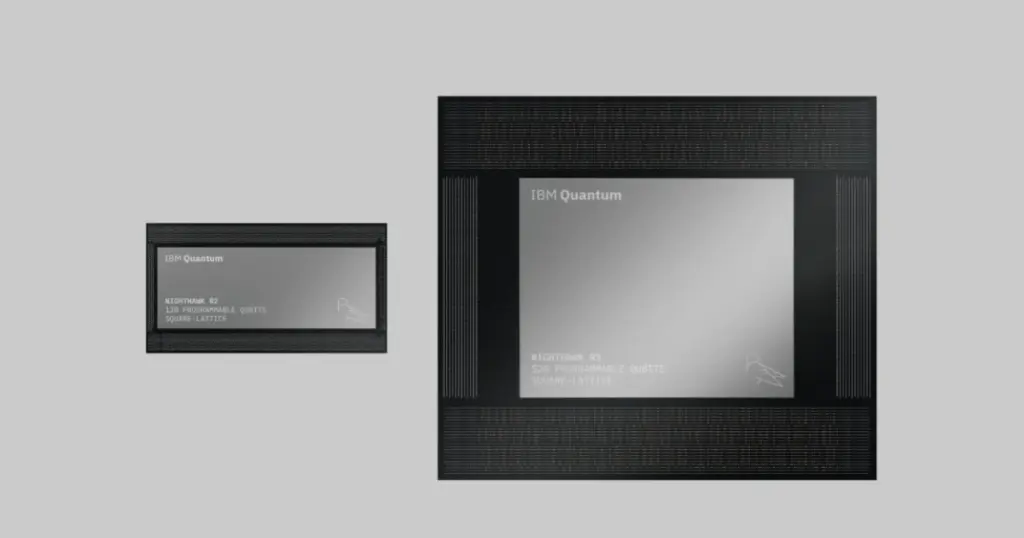
- IBM aims to deploy a 1,040-qubit quantum system by 2027, achieved by linking two Nighthawk r3 processors.
- The upcoming Nighthawk r3 processor will feature 520 programmable qubits, capable of executing 10,000 quantum operations.
- IBM is targeting the development of fault-tolerant quantum computers by 2029, capable of millions of operations.
IBM Scales Quantum Computing with Nighthawk r3
At its recent Quantum Developer’s Conference, IBM provided an updated roadmap, detailing ambitious plans for scaling quantum computing capabilities. A central component of this strategy is the Nighthawk r3 processor, which will form the foundation for a 1,040-qubit system slated for 2027.
The next generation of Nighthawk processors will significantly expand on previous iterations. While the current Nighthawk r2, released in September, offers 120 qubits and can handle 7,500 operations, its successor, the Nighthawk r3, will feature 520 programmable qubits and execute 10,000 quantum operations. This represents more than a fourfold increase in qubit count and enhanced performance, enabling the tackling of larger, more complex problems while maintaining speed and accuracy.
Linking Systems for 1,000+ Qubits
In 2027, IBM plans to link two Nighthawk r3 processors into a single system, creating a combined 1,040-qubit system. This will be facilitated by 10 chip-to-chip interconnects, known as l-couplers, a technology previously tested with Nighthawk r1 processors. While initial plans considered linking up to nine systems, the focus has shifted to a two-processor cluster. The total number of qubits planned for next year remains consistent, though the method of achieving this will differ.
Customers are already reporting speedups of up to 19x on the current Nighthawk chip, underscoring the potential of the upcoming generation.
Nighthawk Processor Specifications
| Feature | Nighthawk r2 (Current) | Nighthawk r3 (Planned) |
|---|---|---|
| Qubit Count | 120 | 520 |
| Quantum Operations | 7,500 | 10,000 |
| Availability | September (Current) | 2027 |
| System Type | Single Processor | Two Linked Processors |
| Total Qubits (Linked System) | N/A | 1,040 (in 2027) |
Towards Fault-Tolerant Quantum Computers
IBM’s ultimate objective is to deliver fault-tolerant quantum computers by 2029. The processor codenamed Starling is envisioned as the world’s first fault-tolerant quantum computer, capable of running quantum circuits comprising 100 million quantum operations on 200 logical qubits. This is an ambitious goal, given that fault-tolerant quantum technology has historically been considered a decade away.
To achieve this, IBM is designing the Starling architecture using modules, each containing a quantum memory and a logical processing unit (LPU). These modules will connect via universal adapters using l-couplers. To enhance error correction efficiency, IBM is also exploring the application of bivariate bicycle quantum low-density parity check (qLDPC) error correction codes, which significantly reduce the number of physical qubits required to store and process quantum information compared to existing surface codes.
Furthermore, IBM is actively collaborating with research institutions. For instance, the company is integrating its quantum processors with classical high-performance computing (HPC) systems to research improved quantum error correction. Examples include a system at Oak Ridge National Laboratory (ORNL), combining an IBM Quantum System Two with Nighthawk r2 quantum processors and the Umbra system, and a partnership with Japan’s RIKEN scientific research institute, where an IBM Quantum System Two is integrated with the Fugaku Arm-based supercomputer.
For developers and researchers, these advancements signify a substantial expansion in quantum computing capabilities. The increased qubit count and operational capacity will enable the tackling of more complex and resource-intensive problems, accelerating data collection for intricate computations. Achieving fault tolerance in the coming years could mark a pivotal moment for the practical application of quantum computers across fields such as materials science, pharmaceuticals, and cryptography.



It’s exciting to see IBM pushing towards 1000+ qubits. I’ve been experimenting with Qiskit on the current Nighthawk r2, and the speedups are definitely noticeable for certain problems, especially optimization tasks. However, dealing with decoherence and error correction still feels like the biggest hurdle; you really have to be smart about circuit depth. My tip for others: start small and thoroughly characterize your noise model before scaling up. The ‘fault-tolerant by 2029’ goal sounds very ambitious, but I’m cautiously optimistic.