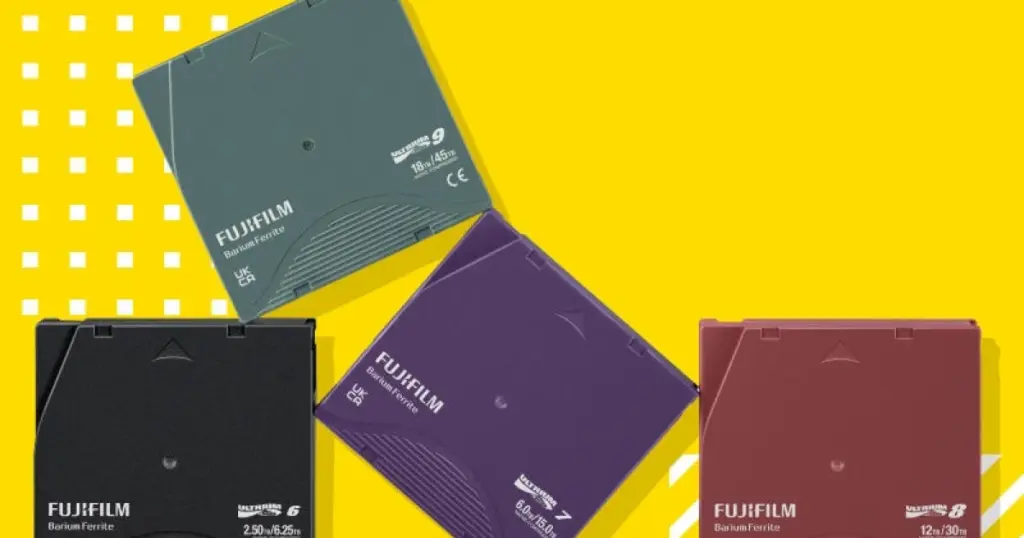
- Fujifilm is investing ¥10 billion ($63.3 million) to increase its magnetic tape production capacity by five times.
- This significant investment, the largest in 20 years, aims to produce advanced LTO Ultrium10 tapes with up to 100TB capacity.
- The surge in demand for magnetic tape storage is primarily driven by the exponential growth of data generated by AI technologies and cloud services.
Japan’s Fujifilm has announced a substantial investment of ¥10 billion (approximately $63.3 million) to expand its magnetic tape production capacity fivefold. This move marks the company’s largest investment in this data storage segment in approximately 20 years, driven by the escalating demand from the artificial intelligence sector.
Investment and Production Expansion
The investment will be channeled into modernizing Fujifilm’s factory in Odawara, near Tokyo. The project is scheduled to run from fiscal years 2026 through 2028, with a significant portion dedicated to boosting the production of advanced magnetic tapes. The primary goal is to increase the output of FUJIFILM LTO Ultrium10 tapes, which are capable of storing up to 100TB of compressed data.
This expansion includes both manufacturing upgrades and an increase in personnel. Fujifilm attributes the necessity for this expansion to the “rapid spread of generative AI and cloud services,” which are causing “exponential growth in the volume of data generated worldwide.” The company emphasizes the increasing importance of establishing secure and efficient environments for storing and utilizing the vast amounts of data accumulated through AI training, inference, and business digitalization.
Magnetic Tape’s Resurgence in the AI Era
Magnetic tape, a technology Fujifilm has been involved with since 1954, initially for television broadcasting equipment, is experiencing a resurgence as a cost-effective and durable solution for long-term ‘cold’ data archiving. While solid-state drives (SSDs) and traditional hard disk drives (HDDs) offer superior performance in terms of access speed, tape storage excels in terms of cost per terabyte and longevity. Research also indicates that tape storage systems are less energy-intensive and more environmentally friendly compared to HDDs and SSDs.
The Linear Tape-Open (LTO) Program, supported by HPE, IBM, and Quantum Corp, is the sole surviving non-proprietary tape format. Despite a slight dip in LTO cartridge shipments in 2025 (160.3 exabytes compared to a record 176.5 exabytes in 2024, attributed to macroeconomic conditions), sales rebounded strongly in the latter half of the year, with the LTO Program predicting record sales in 2026. Fujifilm’s optimistic outlook aligns with this forecast.
LTO Roadmap and Market Dynamics
The LTO roadmap outlines significant capacity increases for future tape generations. The current 10th generation LTO Ultrium tapes offer native storage capacities of 30TB or 40TB, with data transfer rates of 400 MB/s. Data compression can more than double these capacities. Future generations promise even greater storage capabilities:
| LTO Generation | Expected Native Capacity | Approximate Release Date |
|---|---|---|
| LTO Ultrium10 | 30TB / 40TB (up to 100TB compressed) | Current |
| LTO 11 | 70TB | ~2029 |
| LTO 12 | 120TB | Post-2029 |
| LTO 13 | 210TB | Post-2029 |
| LTO 14 | 365TB | Post-2029 |
Compared to SSDs, which currently top out around 256TB at considerably higher costs, magnetic tapes remain an attractive solution for massive archival storage. The demand for AI data center storage is so high that it is at the heart of a global shortage, leading to skyrocketing prices. Other storage manufacturers, such as Toshiba, Kioxia, and SanDisk, are also increasing production of hard disks and 3D NAND flash to meet this demand. For instance, Anduril and Qualcomm recently launched BlueChip, underscoring the broader need for robust and scalable data solutions.
Fujifilm’s significant investment in magnetic tape production underscores the enduring relevance of traditional storage technologies in an era of explosive data growth driven by artificial intelligence. For businesses and data centers, this means a continued supply of cost-effective and highly scalable solutions for long-term data archiving, which is crucial for managing the massive datasets generated by AI training and operations. This move solidifies magnetic tape’s position as a fundamental component of data center infrastructure, particularly for ‘cold’ storage where access speed is not the primary concern, ultimately contributing to lower overall storage costs and enhanced data preservation reliability.



We’ve been using LTO-8 for our archival backups for a few years now, and it’s been a lifesaver for long-term cold storage. The cost per TB is unbeatable, and the reliability has been excellent – we haven’t had a single tape failure yet. The main drawback is definitely the access speed; retrieving specific files can be a bit of a wait. For anyone considering it, make sure your backup software supports proper indexing to minimize seek times. It’s great to see Fujifilm investing more, especially with the AI data explosion.