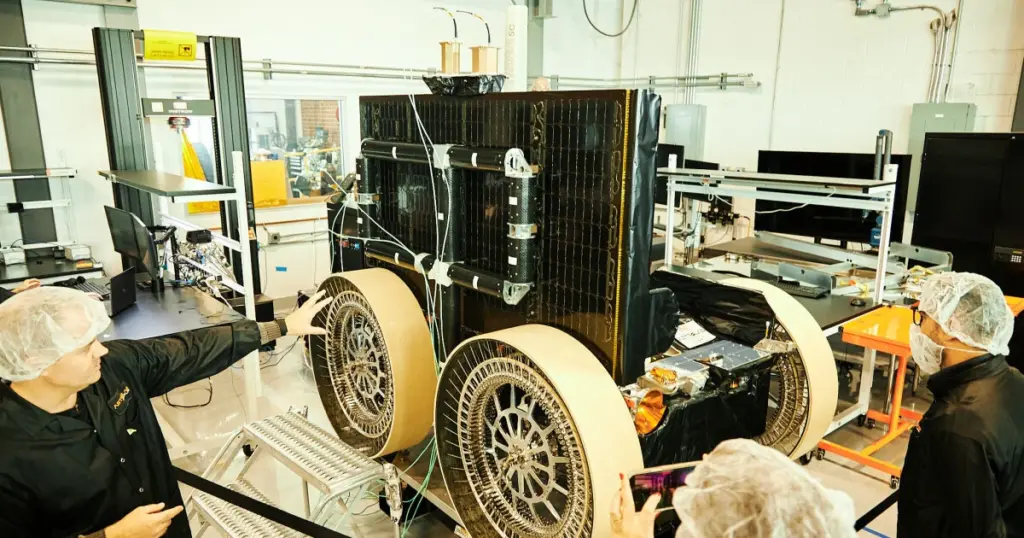
- Hewlett Packard Enterprise will deploy the Spaceborne Computer-4 module to the Moon aboard Astrolab’s FLIP lunar rover.
- The fanless system will execute the first extraterrestrial supercomputer benchmarks (HPL and HPCG) and run local generative AI models.
- The mission is scheduled for launch in late 2026 via a SpaceX Falcon Heavy rocket under NASA’s CLPS initiative.
Edge AI and Supercomputing Head to the Lunar South Pole
Hewlett Packard Enterprise (HPE) is preparing to take autonomous data processing beyond Earth’s orbit with the launch of its fourth-generation compute platform, Spaceborne Computer-4 (SBC4). Integrated aboard Astrolab’s Flex Lunar Innovation Platform (FLIP) rover, the hardware will land near Mons Mouton at the lunar south pole via Astrobotic’s Griffin-1 lander under NASA’s Commercial Lunar Payload Services (CLPS) program.
Targeting launch in late 2026 aboard a SpaceX Falcon Heavy, the mission is set to run for a full year. FLIP will act as a real-world testbed for lunar economy infrastructure, prioritizing local edge computing to counter extreme communications latency and bandwidth bottlenecks between the Moon and Earth.
Custom Engineering and Off-the-Shelf Reliability
Unlike the rack-mounted, water-cooled original Spaceborne Computer launched to the ISS in 2017, SBC4 is a fanless, miniaturized blade measuring roughly 10 inches long, 4 to 5 inches wide, and one inch thick. Designed to dissipate thermal loads directly into the FLIP rover’s chassis plates, the unit operates within strict power and heat budgets.
The system pairs a low-power CPU and specialized GPU with a mirrored array of commercial-grade Kioxia BG6 M.2 NVMe SSDs delivering 1 TB of total storage. Drawing on nine years of orbital compute operations, HPE is utilizing a technique described as “hardware hardening in software.” By continuously tracking hardware metrics against predefined state tables, SBC4 can automatically throttle clock speeds or enter hibernation states during severe radiation events or extreme temperature shifts.
| Specification | HPE Spaceborne Computer-1 (2017, ISS) | HPE Spaceborne Computer-4 (2026, Lunar Surface) |
|---|---|---|
| Form Factor | Standard rack-mount, liquid cooling | Fanless compact blade (~10×4-5 inches) |
| Weight | 124 lbs (~56 kg) | Ultralight custom blade built for rover payload |
| Storage Array | Early enterprise solid-state drives | 1 TB Kioxia BG6 NVMe SSDs (software RAID 1) |
| Core Workloads | HPL, HPCG (>1 TFLOP/s) | HPL, HPCG, LLMs with RAG, LiDAR vision processing |
| Target Environment | Low Earth Orbit (Pressurized ISS cabin) | Lunar South Pole (Mons Mouton, vacuum conditions) |
LLM Reasoning, Autonomous Vision, and Top500 Benchmarks
During the mission, HPE will execute High Performance Linpack (HPL) and High Performance Conjugate Gradients (HPCG) benchmarks, setting up the first-ever Top500 entry submitted from a celestial body. Beyond scientific prestige, running these demanding workloads will generate internal thermal energy to help the hardware survive freezing 14-day lunar nights.
NASA will use the platform to evaluate its FLUID (Federated Learning for Unbounded and Intelligent Decentralization) model alongside tuned large language models (LLMs) with retrieval-augmented generation (RAG) to interpret technical documents locally. The GPU will also process camera and LiDAR telemetry in real time for terrain mapping and autonomous navigation, while Deloitte will test its Silent Shield predictive intrusion-detection software.
Deploying powerful computing clusters directly on planetary rovers transforms deep-space operations. Instead of waiting on multi-second latency and constrained downlinks to stream massive sensor feeds, lunar missions can process data at the edge and transmit actionable insights back to Earth.


Relying on commercial off-the-shelf SSDs and software-based hardening in the harsh radiation environment of the lunar south pole seems exceptionally risky. Beyond the PR value of running Top500 benchmarks, I wonder if the massive thermal swings during the 14-day night will induce solder fatigue that no amount of throttling can fix.