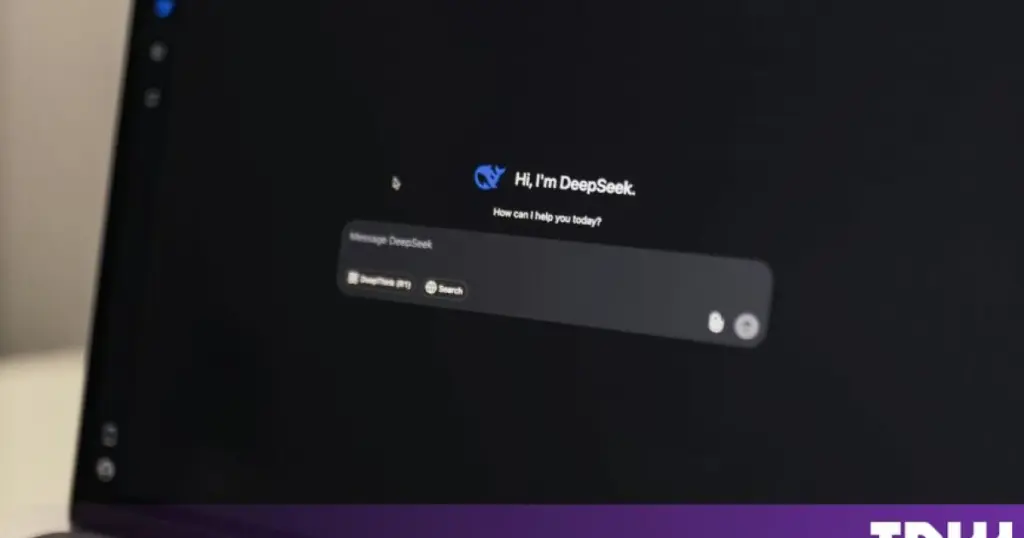
- The US Department of Homeland Security (DHS) ordered all civilian federal agencies to purge DeepSeek products from their IT infrastructure.
- The ban broadly covers third-party software built using DeepSeek implementations as well as indirect routing via AI gateways.
- The order follows earlier restrictions by the Pentagon, NASA, and the House of Representatives amid fears of data transfer to the Chinese government.
Federal Directive Against Chinese AI Implementations
The US Department of Homeland Security (DHS) has officially instructed federal civilian agencies to eliminate products developed by Chinese artificial intelligence lab DeepSeek from their internal systems and immediately halt further acquisitions. Enacted under a 2018 supply chain security law, the directive arrived just days after DeepSeek rolled out its latest AI model.
Officials cited substantial national security concerns, emphasizing the danger that sensitive data and user prompts could be routed to DeepSeek’s infrastructure and accessed by the Chinese government.
Broad Scope and Technical Compliance Headaches
The DHS directive is notably sweeping: agencies are instructed to purge “all DeepSeek and DeepSeek-affiliate products, and third-party products and services developed using DeepSeek implementations.” Industry cybersecurity specialists point out that enforcing this standard poses immense logistical challenges:
- Ambiguous terminology: The order leaves undefined whether “developed using” restricts active API connections or covers applications whose underlying code was written or tested with DeepSeek assistance.
- AI routing gateways: Aggregators such as OpenRouter and Vercel AI Gateway automatically direct developer requests to optimal models. Without deliberate safeguards, government workloads could inadvertently ping DeepSeek endpoints.
- Verification limits: Standard AI software bills of materials (SBOM) do not track developer tooling, making it practically impossible to verify whether a third-party application interacted with DeepSeek during its lifecycle.
Escalating Government Restrictions and Vulnerability Concerns
Scrutiny of DeepSeek expanded significantly following the rollout of DeepSeek-R1 in early 2025. On February 6, 2025, US Representatives Darin LaHood and Josh Gottheimer introduced the No DeepSeek on Government Devices Act. While that legislation stalled in committee, defense and administrative bodies took swift unilateral action.
| Agency / Body | Enforcement Action | Core Motivation |
|---|---|---|
| Pentagon (DISA) | Blocked on IT networks (Jan 2025) | Military IT supply chain defense |
| US Navy, NASA, House of Reps | System-wide restrictions (2025) | Data capture and espionage concerns |
| Civilian Agencies (DHS) | Full ban on tools & derivatives | 2018 Supply Chain Security Law |
Concerns were compounded by technical audits of DeepSeek software. A December 2025 security assessment of DeepSeek’s Android and iOS applications revealed plain-text data exposures, connections to servers managed by Chinese tech firms, and a lack of SSL pinning. Furthermore, National Institute of Standards and Technology (NIST) evaluations indicated that DeepSeek models exhibited higher susceptibility to prompt injection and jailbreaking compared to domestic US counterparts.
As automated software threats accelerate worldwide - highlighted by incidents where a hacker deployed an army of AI agents to infiltrate over 100 corporate websites - maintaining rigorous guardrails on critical infrastructure remains a top priority.
Government contractors and enterprise vendors must thoroughly audit their development pipelines to ensure zero dependence on DeepSeek models, including US-hosted deployments. While this decision gives American AI labs like Anthropic a major competitive boost in public sector procurement, agencies may face higher software costs without access to budget-friendly open-weight models.


We run DeepSeek-R1 locally via Ollama for code refactoring, and the logic performance is phenomenal for the price. However, their official mobile apps and hosted endpoints are definitely leaky. If you want to use it safely, run the open-weights model air-gapped on your own hardware and explicitly block fallback routing in your AI gateways.