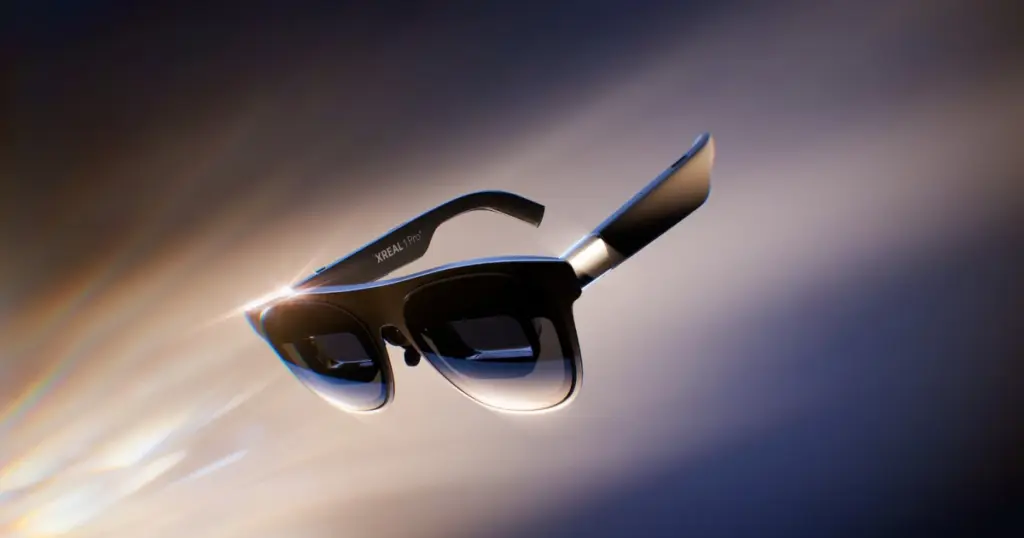
- Xreal has refreshed its flagship wearable display line with the new 1 Pro+ glasses.
- Screen peak brightness jumps from 700 to 1,200 nits, alongside upgraded 60fps 2D-to-3D conversion.
- The retail launch price remains unchanged at $599.
Hardware refinements without a price hike
Ahead of the planned launch of its Android XR-based Aura headset later this year, Xreal has updated its flagship wearable display portfolio with the introduction of the Xreal 1 Pro+ (One Pro+). The company maintained the original introductory price point, offering the hardware upgrade at $599.
Display enhancements and spatial performance
The core upgrade in the new model is focused on visual fidelity and wearer comfort. While retaining 0.55-inch Sony Micro-OLED panels with a 1920×1200 resolution and a 120Hz refresh rate, the peak brightness level has climbed significantly from 700 nits to 1,200 nits.
Spatial viewing capabilities have also improved: the hardware now handles real-time 2D-to-3D conversion at 60fps, double the 30fps rate supported by the previous generation. Xreal is also highlighting a new AI HDR processing feature designed to enhance overall contrast and dynamic range.
| Specification | Xreal 1 Pro | Xreal 1 Pro+ |
|---|---|---|
| Peak Brightness | 700 nits | 1,200 nits |
| 2D to 3D Conversion | 30 fps | 60 fps |
| Panel Size & Type | 0.55-inch Sony Micro-OLED | 0.55-inch Sony Micro-OLED |
| Resolution & Refresh Rate | 1920×1200, 120Hz | 1920×1200, 120Hz |
| Starting Price | $599 | $599 |
Privacy-first design
In line with previous iterations, the Xreal 1 Pro+ deliberately omits outward-facing cameras. The device remains purely focused on personal display experiences, avoiding bystander privacy concerns in public spaces.
Buyers looking for portable external monitors or media viewing get markedly better outdoor readability and smoother 3D spatial rendering without having to pay a premium over the previous generation.


Pumping the brightness up to 1,200 nits sounds great on paper, but I worry about thermal management and battery drain on the host device. Real-time 2D-to-3D conversion at 60fps also tends to cause artifacts and eye fatigue in practice. At $599, it is still a steep asking price for what is essentially just a wearable monitor.