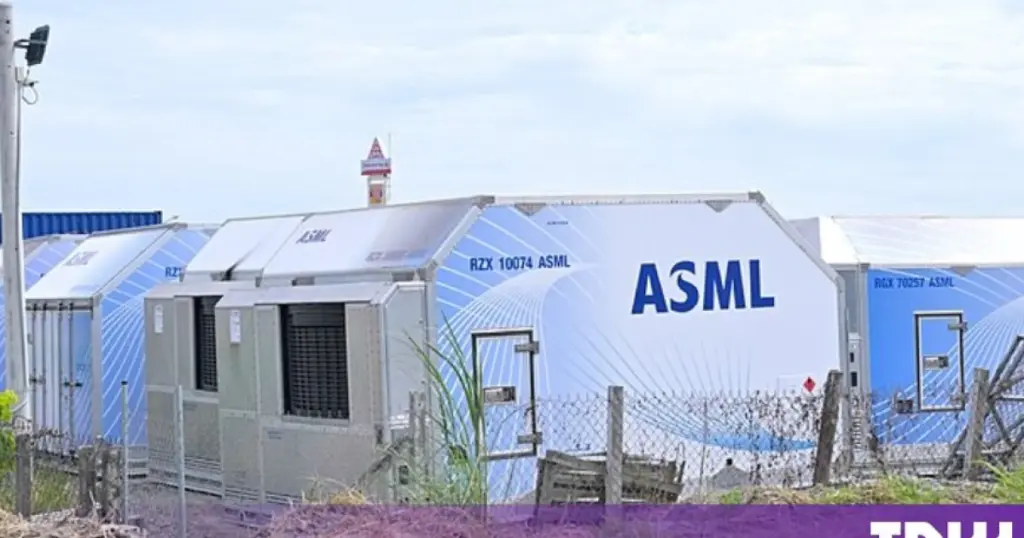
- What happened: ASML delivered record Q3 2026 revenue of $13.06 billion (€11.66 billion) and warned it will be unable to fully satisfy lithography machine demand in 2027 and 2028.
- Key metrics: Net sales surged 55% year-over-year, gross margins reached an all-time high of 57.5%, and full-year guidance was raised to €44–€45 billion ($49.3–$50.4 billion).
- Who is affected: Major chip fabricators (TSMC, Samsung, Intel, Micron, SK Hynix) and hyperscalers funding unprecedented artificial intelligence hardware buildouts.
Dutch lithography giant ASML has posted record financial results for the third quarter of 2026, confirming that global demand for advanced semiconductor manufacturing tools is accelerating rather than cooling off. Unprecedented investments in artificial intelligence infrastructure have led chipmakers to place orders stretching into 2029 and 2030, leaving ASML unable to meet supply needs over the next four years despite massive capacity expansion plans.
Record Financial Performance in Q3 2026
ASML reported quarterly revenue of $13.06 billion (€11.66 billion), representing a 55% jump year-over-year and a 25% sequential increase. Operating income rose to $5.79 billion (€5.17 billion), pushing net income to $5.56 billion (€4.96 billion)—a sum that includes a €510 million ($570 million) gain from the revaluation of its stake in Mistral AI. Gross margin hit a record 57.5%, up from 51.6% in Q3 2025.
The company shipped 121 lithography systems during the quarter (113 new and 8 refurbished units), generating $4.59 billion from 17 EUV scanners and $4.82 billion from 85 DUV tools. Advanced logic chipmakers generated 54% of equipment sales, while memory makers accounted for the remaining 46%.
| Region | Equipment Sales Share (Q3 2026) | Primary Growth Drivers |
|---|---|---|
| Taiwan | 32% | TSMC advanced node expansion (N2/A16) |
| South Korea | 31% | Samsung and SK Hynix DRAM and memory buildouts |
| China | 23% | Legacy DUV tools amid export control boundaries |
| United States | 13% | Domestic fab expansions by Intel and partners |
| Rest of Asia | 1% | Regional trailing-edge foundries |
Capacity Bottlenecks Extend Through 2028
ASML CEO Christophe Fouquet noted that top foundry customers now have extended visibility into multi-year purchase commitments from their clients. “This extended visibility has led them to conclude that demand for their products will outpace supply through at least 2028,” Fouquet stated during the earnings call, pointing out that customers are already securing delivery slots for 2028, 2029, and 2030.
ASML plans to manufacture roughly 65 Low-NA EUV scanners in 2026, up from 44 in 2025. While earlier roadmaps scheduled a 30% capacity expansion in 2027 and another potential 30% hike in 2028—scaling potential output to ~110 Low-NA systems—CFO Roger Dassen acknowledged that these planned output levels will still fail to meet customer requirements, prompting ASML to evaluate even larger production expansions.
New Tool Roadmaps and Value-Based Pricing
To unlock extra wafer output without requiring more cleanroom floor space, ASML is preparing next-generation lithography hardware:
- Twinscan NXE:3800F: Slated for early 2027, boasting throughput of 260 wafers per hour (a 13% uplift over the NXE:3800E), providing 21,600 additional EUV exposures per tool each month.
- Critical-Layer Immersion DUV: A new high-productivity immersion tool processing up to 330 wafers per hour.
- High-NA EUV Progress: Tool fleet availability is nearing 90%. Intel has exposed over 1 million test wafers and targets HVM insertion on its 14A node in 2028. Samsung plans High-NA adoption for DRAM in 2028, while TSMC looks toward 2030–2031.
The intense demand for bleeding-edge silicon mirrors structural hardware shifts explored in our guide on local AI hardware in 2026. Furthermore, ASML confirmed it has finalized talks regarding value-based pricing with key customers. Price hikes on new tool orders will begin surfacing during 2027 and reach full impact across 2028 and beyond.
ASML’s persistent equipment shortfall confirms that the AI hardware buildout is far from exhausting its momentum. Because cutting-edge logic and High Bandwidth Memory (HBM) rely entirely on ASML’s EUV monopoly, wafer supply constraints will keep foundry pricing high, directly influencing the cost structure of data center accelerators and consumer flagships through 2028.



The fact that delivery slots are already being locked down into 2030 is mind-boggling. Are we looking at a long-term bottleneck for AI accelerators if ASML can’t scale Low-NA and High-NA tools fast enough? I wonder how much of this crunch will push foundries to optimize older nodes or focus on advanced packaging instead.