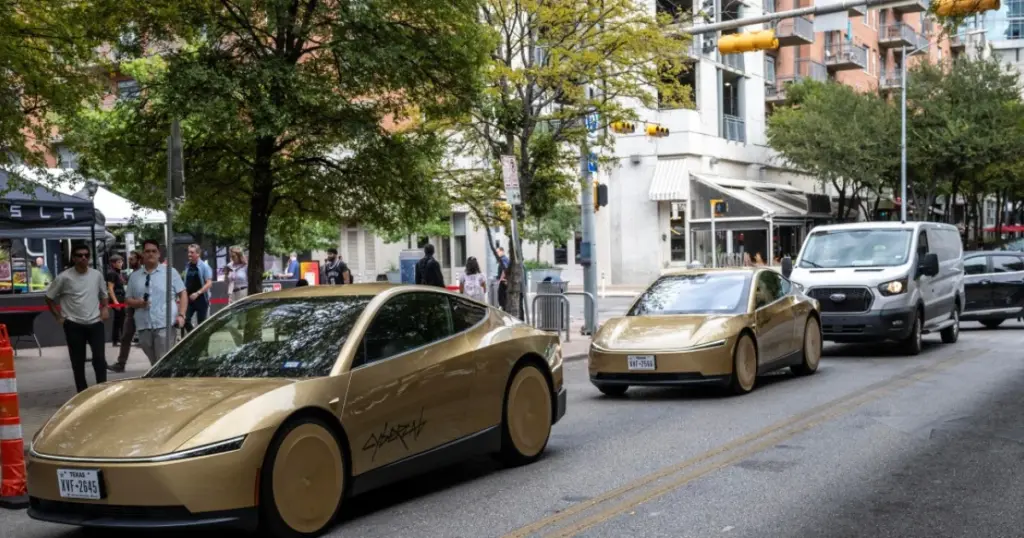
Hidden Manual Controls Unveiled in Tesla Cybercab
The recent launch of the Tesla Cybercab service in Austin, Texas, has allowed initial riders to share their experiences. Contrary to its design, which notably lacks a steering wheel and pedals, some users have uncovered secret manual controls. This revelation comes less than a week after the official debut of the autonomous vehicle, challenging the initial perception that there was no way for the vehicle to be manually operated.
Virtual Joystick on Central Touchscreen
One passenger unexpectedly discovered that the Cybercab can be manually controlled through its central touchscreen display. These functions are presented as a virtual joystick, offering a degree of manual input despite the vehicle’s primary autonomous design. This finding is particularly surprising given the company’s emphasis on the Cybercab’s fully autonomous nature and the absence of traditional physical controls.
Real-World Challenges in Austin
Beyond its technical specifications, the Tesla Cybercab has also encountered practical challenges in real-world scenarios. A rider recounted an embarrassing incident where the gold-painted two-seater partially obstructed a narrow road near a popular Austin swimming spot. This caused inconvenience for other drivers seeking parking, highlighting potential issues with how the autonomous vehicle interacts with existing urban infrastructure and traffic flow.
While the Cybercab’s autonomous vision is intriguing, the revelation of ‘secret’ manual controls, even virtual ones, raises questions about the true readiness of the technology. If full autonomy is the goal, why the hidden fallback? This, coupled with real-world incidents like obstructing traffic, suggests the implementation might be more complex and costly in terms of urban integration than initially presented. It makes one wonder about the actual timeline for widespread, truly driverless adoption.