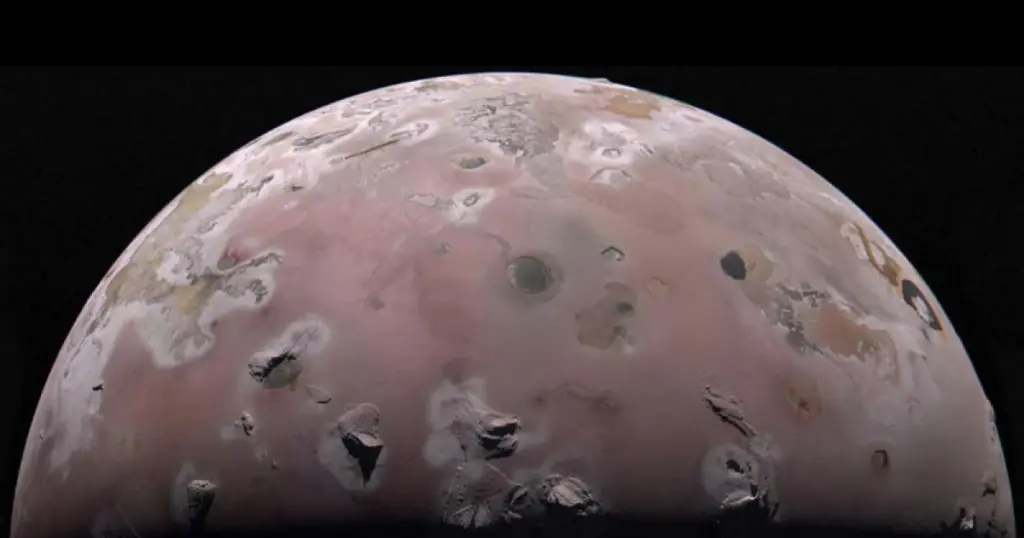
Juno Reveals Io’s Subsurface Heat: A Glimpse Beneath the Most Volcanic World
NASA’s Juno spacecraft has achieved a significant milestone, providing the first measurements of temperature not just on the surface, but also within the shallow subsurface layers of Io, the most volcanically active body in the Solar System. These observations indicate that the moon’s rocks are notably heated from within, even at depths of just a few meters. The methodology employed for these measurements offers new avenues for studying volcanism, including on Earth.
New Insights into Volcanic Worlds
The Juno mission’s findings reveal substantial heating in Io’s shallow subsurface. Data collected during two close flybys also suggest that much of Io’s surface is surprisingly smooth and composed of very low-density material. These results were published in the “Journal of Geophysical Research: Planets” on Wednesday.
Io’s extreme volcanism is driven by tidal heating. The moon is continuously stretched and squeezed by Jupiter’s immense gravity as it orbits along a slightly elliptical path, generating internal heat that far surpasses Earth’s heat output. Previously, almost all knowledge about this internal heat was based on infrared observations, which only capture the temperature of the uppermost surface layer. The latest data were acquired using the Microwave Radiometer (MWR) instrument aboard the spacecraft.
Implications for Earth Sciences
Scientists note that the technique used to study Io could be applied to analyze volcanic activity on other celestial bodies, including Earth. This opens new perspectives in understanding geological processes on both fiery and icy worlds beyond our planet.
It’s fascinating to see Juno’s MWR data finally providing subsurface temperatures for Io. I’ve been experimenting with similar microwave radiometry techniques in my own lab work, albeit on a much smaller scale for material characterization. The challenge is always calibration and accounting for emissivity variations, especially with such extreme volcanic activity. I wonder how they’re isolating the tidal heating signature from localized magma plumes. My tip for anyone working with similar remote sensing data is to always cross-reference with other spectral bands if possible – it helps immensely with disambiguation.