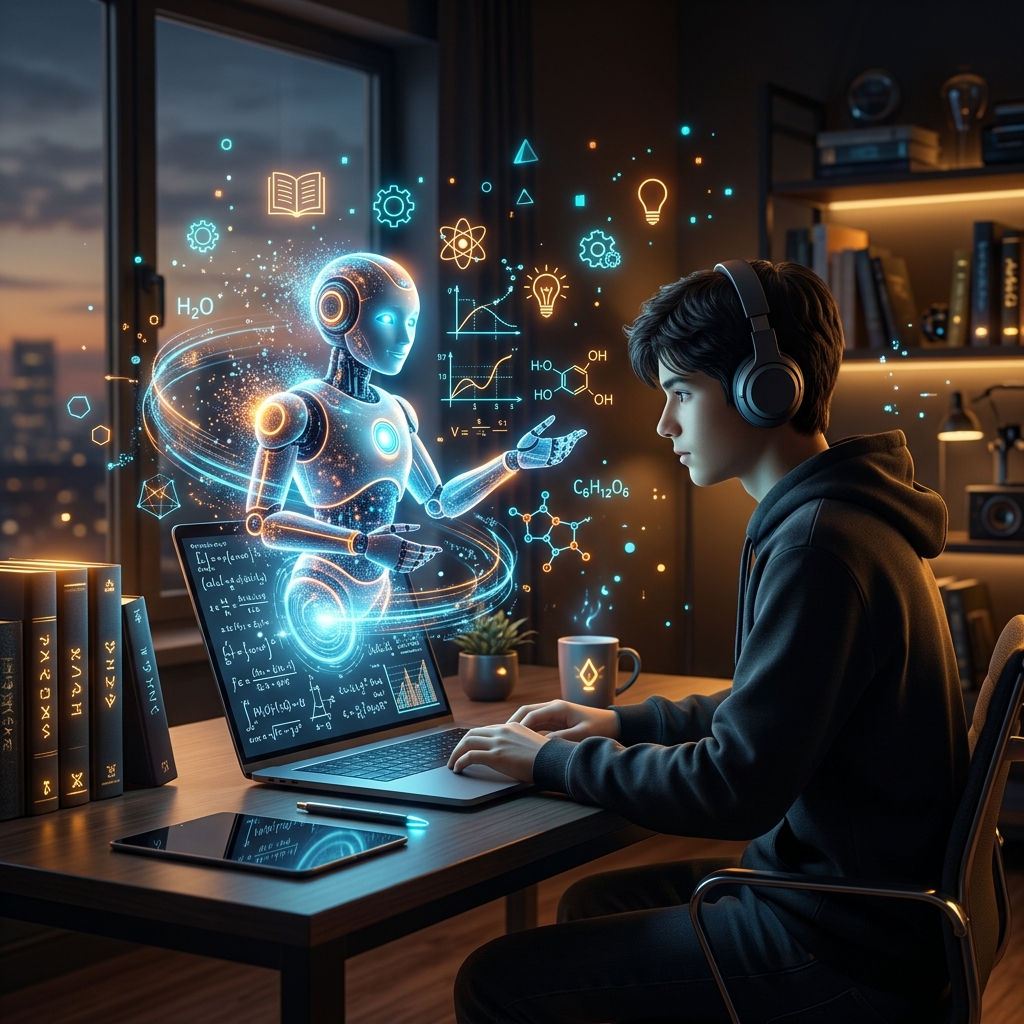
Schoolchildren use ChatGPT to write essays. Students ask a neural network to solve math problems. Teachers are simultaneously excited about new opportunities and panicked by the threat of cheating. The topic of AI in education is causing controversy in parent-teacher conferences, teachers’ lounges, and ministries of education around the world.
The truth, as usual, is more complex than the simple slogans “AI is killing education” or “AI will solve all school problems.” Let’s look at the essence.
How AI really helps with your studies
Personal tutor available 24/7
The main advantage of neural networks in learning is endless patience and accessibility. The child did not understand the topic in the lesson – there is only one teacher for 30 people, it is physically impossible to repeat the material individually. The neural network is ready to explain the same topic in ten different ways, as many times as you like, at any time of the day, without irritation or haste.
If a student does not understand quadratic equations, you can ask them to explain them through analogies, through visual images, through practical examples, until understanding appears.
Explanation at an understandable level
Good neural networks are able to adapt the complexity of the explanation. You can directly ask: “explain as for a fifth-grader” or “explain at the level of a second-year student at the Faculty of Physics” – and receive an answer that corresponds to your level of preparation.
Training through dialogue
AI can act as an interlocutor for language practice, role-playing dialogues on history, and simulating debates on ethical issues. This is an interactive learning format that is difficult to achieve in a large classroom.
Help with text feedback
The student wrote an essay – the neural network can point out weaknesses in argumentation, structure, grammar, and suggest how to improve specific paragraphs. This is not a replacement for a teacher, but an additional circle of feedback available instantly.
Preparing materials for self-test
You can ask the AI to create a test on a topic you just learned, a set of flash cards for memorizing terms, or practice problems of varying difficulty levels.
Real risks that need to be discussed honestly
Atrophy of independent thinking skill
The main risk is not cheating as such, but the gradual loss of the ability to formulate one’s own thoughts and solve problems without outside help. If a child starts writing any text from the fifth grade to an AI, he is not training the skills of writing and structuring arguments – and these are skills that are needed for life, far beyond school grades.
The illusion of understanding
A student can copy a solution to a problem that looks logical and correct – but if he has not gone through the thinking process himself, the knowledge is not consolidated. On a test without access to AI, it turns out that the material has not been mastered.
Factual errors in the training material
As explained in one of the previous articles about “hallucinations” of neural networks, AI can reliably produce inaccurate information. For a child who does not yet know how to critically evaluate sources, this is especially dangerous – he can learn incorrect facts, taking them on faith.
Inequality of access
Paid versions of advanced models create a new kind of digital divide – some have access to the best learning tools, others do not.
How to use AI in your studies correctly
The principle of “first yourself, then AI”
The most important principle: try to solve the problem yourself before turning to the neural network. This keeps your mind trained and at the same time makes it possible to get help when you really need it.
AI as an explanation, not as a ready-made answer
Instead of “solve for me” – “explain the principle of how such problems are solved”, “show a similar example with other numbers so that I can try it myself.” This preserves the educational value of the interaction.
A test, not a replacement for critical thinking
Use AI to test your reasoning: “I think this is the cause of the historical event – do you agree, or are there arguments against it?” Such dialogue develops analytical skills, rather than replacing them.
Transparency with teachers
Many educational institutions are forming policies on the use of AI – where it is allowed and where it is prohibited. Open discussion with teachers about how AI assistance is used creates a healthy culture, rather than a culture of sneaky rule-bending.
Always check actual accuracy
Any specific facts, dates, figures, quotes received from AI for educational work must be checked through additional sources – textbooks, encyclopedias, reliable sites.
What the research says
Educational researchers have not yet come to a common conclusion – too little time has passed since the mass dissemination of generative AI for long-term longitudinal studies. Interim data shows a mixed picture: AI tools help weak students close basic gaps more quickly, but if used carelessly, they can hinder the development of advanced skills in strong students who could solve problems on their own.
This means that there is no universal correct answer “to use or not to use” – the method of use, the age of the student, the subject and the specific task are important.
Output
AI in education is a powerful tool, the effect of which depends entirely on the method of application. Used as a tutor and aid in explaining complex concepts, it enhances learning. Used as a machine to automatically complete tasks, it undermines the very purpose of education – the development of thinking.
The key task of parents and teachers is not to prohibit or blindly allow, but to teach children the conscious, responsible use of a powerful tool that will definitely remain a part of their educational and professional life.