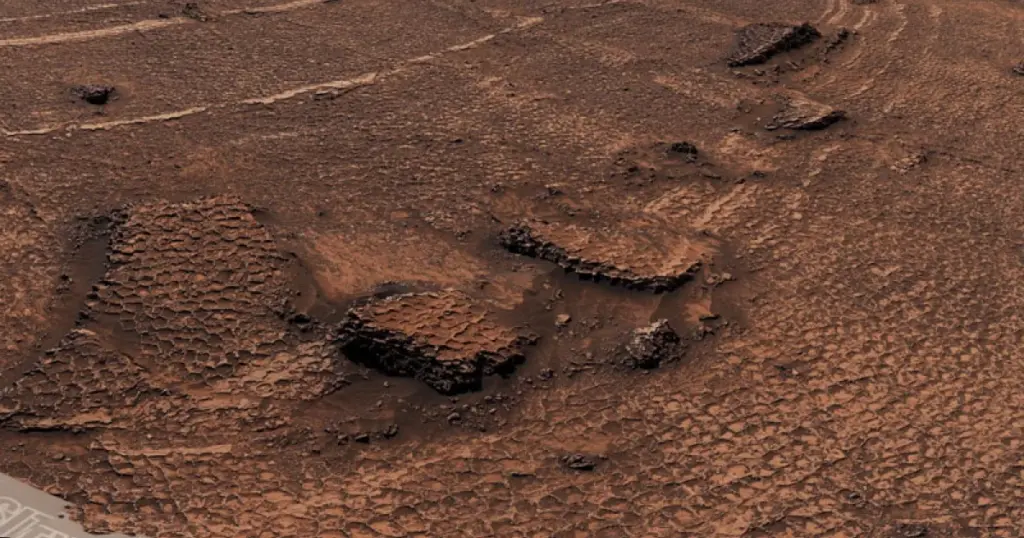
Curiosity Unveils Martian Geological Wonders
NASA’s Curiosity Mars rover has made a significant discovery within Gale Crater, revealing an extensive area covered in small, polygonal structures reminiscent of honeycombs. This latest finding, dubbed a “sea of polygons,” represents the largest such geological formation ever observed by the rover on the Red Planet, dwarfing previous discoveries of similar features.
Details of the Unusual Terrain
While Curiosity has previously captured images of similar polygonal fractures, these were typically found in small, isolated patches. The new discovery in a Martian valley called Valle Grande showcases a far more expansive field of these unique shapes. Each individual polygon measures approximately 1.5 to 3 inches (3.8 to 7.6 cm) wide, forming an intricate and previously unseen landscape. These honeycomb-shaped polygons offer crucial evidence of geological processes that occurred billions of years ago, providing scientists with valuable insights into the planet’s history.
Scientific Implications
The identification of such a massive field of polygonal structures opens new avenues for understanding Mars’ water history and past climatic conditions. NASA scientists hypothesize that these formations could have resulted from cycles of wetting and drying of the Martian soil, suggesting the potential existence of surface water bodies in the planet’s ancient past. Further analysis of the data collected by Curiosity will help elucidate the mechanisms behind the formation of these enigmatic Martian landscapes.
The discovery of such an expansive ‘sea of polygons’ by Curiosity within Gale Crater significantly enhances our understanding of Mars’ paleohydrology. The scale of these structures, with individual polygons measuring 3.8-7.6 cm, points to prolonged and cyclical wetting-drying processes, likely involving shallow surface water. This observation provides critical evidence supporting models of a more hydrologically active ancient Mars, impacting our assessment of past habitability potential and the evolution of its regolith.